Why Linear Actuators Are Essential for Hospital Beds

Introduction

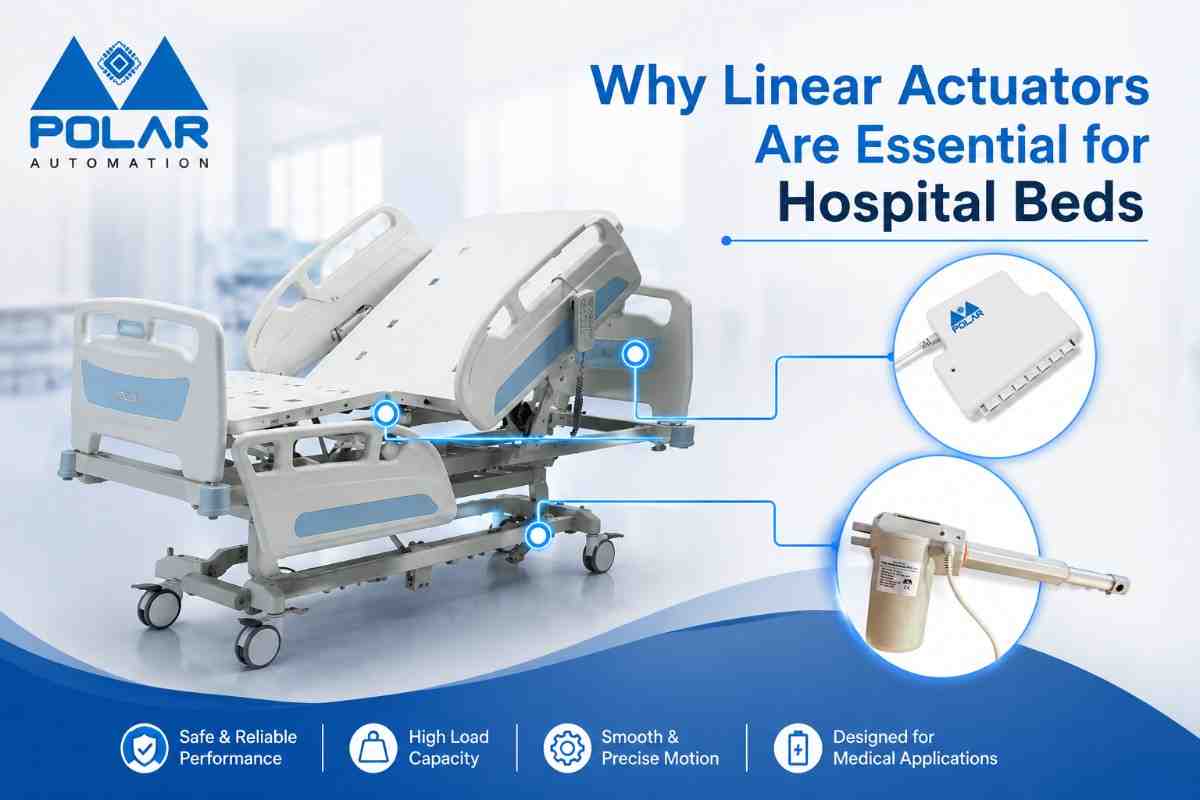
Modern hospital beds do much more than provide a place for patients to rest. Linear actuators for hospital beds play a key role in making these functions possible. They help healthcare professionals position patients safely, improve comfort, and perform routine care with less physical effort.

A linear actuator converts electrical energy into controlled linear movement. In a hospital bed, it can raise the bed, adjust the backrest, move the leg section, or tilt the complete bed platform. Multiple actuators can also work together through a hospital bed actuator control system to create several independent bed functions.

As hospitals and medical equipment manufacturers demand safer and more flexible patient-care solutions, reliable linear actuator systems have become an important part of modern electric hospital bed design.

What Is a Linear Actuator?

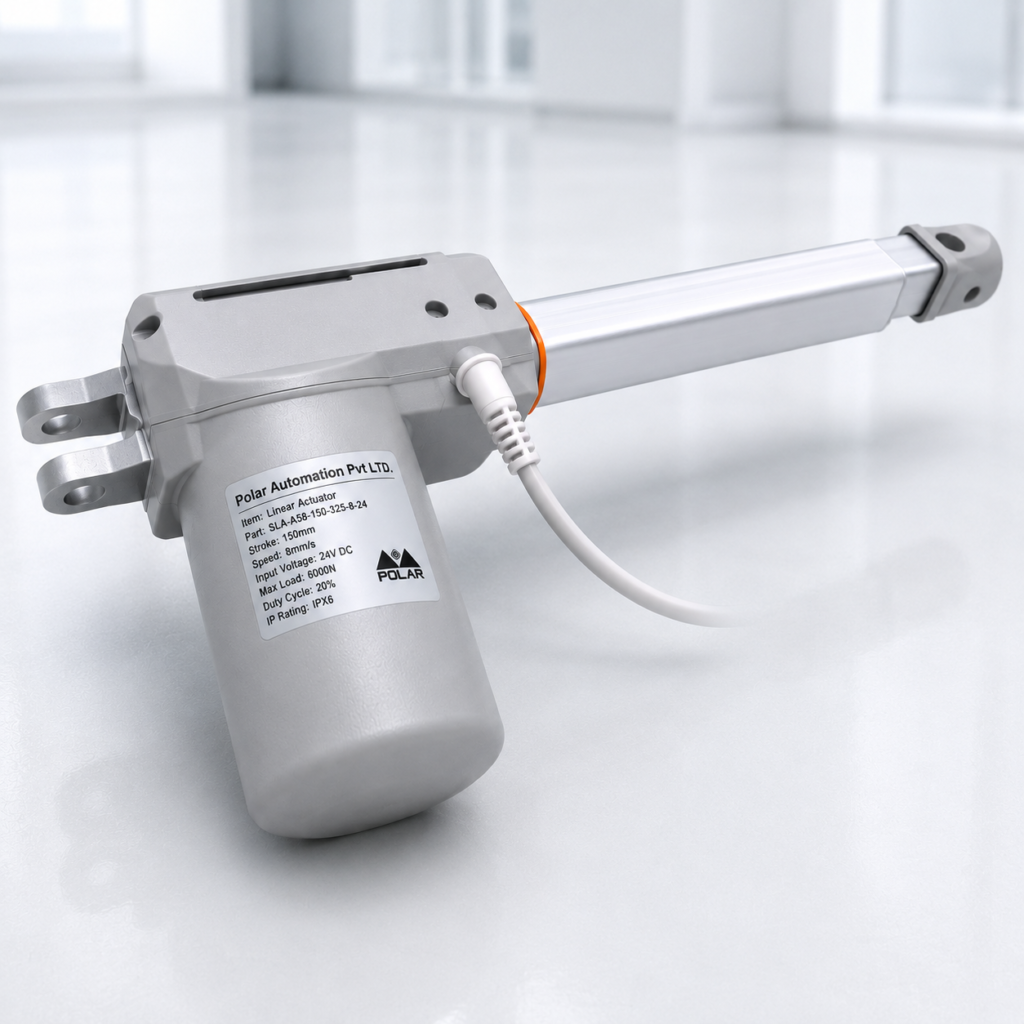
A linear actuator is an electromechanical device that creates straight-line movement. Unlike a rotary motor, which produces rotational movement, a linear actuator extends or retracts a moving shaft.

A typical electric linear actuator includes a motor, gearbox, screw mechanism, moving rod, and limit switches. When the control system sends a signal, the motor drives the screw mechanism. The rod then moves forward or backward.

In a hospital bed, this movement connects directly to a mechanical section of the bed.

For example:

Controller → Control System → Linear Actuator → Bed Movement

When the user presses a button to raise the backrest, the control system activates the relevant actuator. The actuator extends or retracts, and the backrest moves to the selected position.

This simple operating principle allows manufacturers to create precise and reliable electric hospital bed adjustment systems.

Why Are Linear Actuators Essential for Hospital Beds?

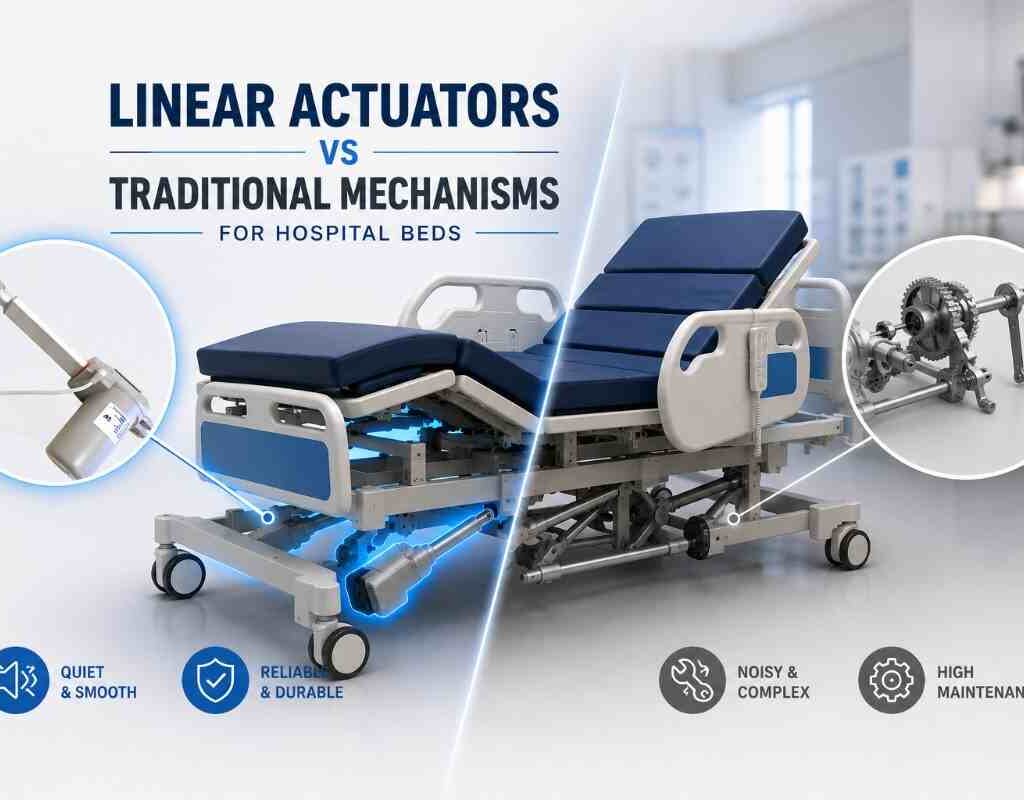
Hospital beds require controlled movement across several sections. Manual mechanisms can perform some of these adjustments, but electric actuators provide smoother operation and easier control.

A single bed may use several actuators. Each actuator can control a specific movement, while the main control unit coordinates their operation.

For example, a multi-function hospital bed may use separate actuators for:

  • Bed height adjustment

  • Backrest adjustment

  • Leg rest adjustment

  • Trendelenburg position

  • Reverse Trendelenburg position

  • Overall bed tilt

This modular approach allows OEMs to design hospital beds according to different clinical and patient-care requirements.

Key Functions of Linear Actuators in Hospital Beds


1. Bed Height Adjustment

A linear actuator can raise or lower the entire bed frame.

Height adjustment helps caregivers create a suitable working position during patient care. It also allows patients to access the bed more easily when the bed reaches a lower position.

The actuator must provide enough force and stroke length to move the bed smoothly while supporting the required load.

2. Backrest Adjustment

Backrest movement allows the upper section of the bed to move from a flat position to an inclined position.

Patients can use this function while eating, reading, communicating, or resting. Caregivers can also adjust the backrest during routine treatment and patient positioning.

A dedicated actuator provides controlled movement without requiring the caregiver to manually lift the backrest.

3. Leg Section Adjustment

A separate actuator can control the leg or knee section of the bed.

This function gives caregivers more control over patient positioning. It can also work together with the backrest actuator to create a comfortable seated or reclined position.

4. Trendelenburg and Reverse Trendelenburg

Some advanced hospital beds use actuators to tilt the complete bed platform.

Trendelenburg tilts the patient’s head lower than the feet, while reverse Trendelenburg raises the head relative to the feet.

These movements require accurate coordination between the bed’s mechanical structure and actuator control system.

5. Bed Tilt

Linear actuators can also support lateral or overall bed tilting, depending on the bed design.

This function gives healthcare professionals additional positioning options. It also demonstrates why actuator synchronization matters in multi-function hospital beds.

Linear Actuator

Benefits of Linear Actuators for Hospital Beds


Improved Patient Comfort

Electric actuator systems allow users to adjust the bed position without manually moving heavy sections. Patients can achieve more suitable positions for rest and daily activities.

Precise Positioning

Linear actuators provide controlled movement. With the right actuator specification and control system, manufacturers can achieve accurate positioning and repeatable movement.

Reduced Manual Effort

Caregivers do not need to manually lift or adjust heavy bed sections. A simple control input can activate the required actuator.

This can make routine patient care more convenient and reduce unnecessary physical effort.

Better Caregiver Ergonomics

Height-adjustable hospital beds allow caregivers to bring the bed to a suitable working level. This can support better ergonomics during bedside procedures and routine care.

Flexible Bed Design

Multiple actuators allow manufacturers to create different bed configurations. A basic bed can use fewer actuators, while an advanced ICU or critical-care bed can use several actuators for more positioning functions.

Smooth and Controlled Movement

Electric linear actuators can provide controlled extension and retraction. When manufacturers match the actuator’s speed, force, stroke, and duty cycle to the application, the bed can achieve consistent movement.

Easier Integration

Modern actuator systems can integrate with hand controllers, nurse control panels, foot switches, and central bed control units. This gives OEMs flexibility when designing the user interface.

Applications of Linear Actuators in Hospital Beds


Linear actuators support many types of medical and healthcare beds.

Hospital Patient Beds

General hospital beds use actuators for common functions such as height, backrest, and leg adjustment. These functions support everyday patient care.

ICU Beds

Intensive care beds often require more advanced positioning. Multiple actuators can work together to provide several controlled movements.

Electric Nursing Beds

Nursing and long-term care facilities can use actuator-driven beds to improve patient comfort and simplify daily care.

Home Care Beds

Electric home-care beds use compact actuator systems to provide powered positioning for patients who need extended support at home.

Rehabilitation Beds

Rehabilitation facilities can use adjustable beds to support different stages of patient recovery and mobility.

Specialty Medical Beds

Special-purpose beds may require additional movement functions. Manufacturers can select actuator configurations based on the specific application and mechanical design.

What Should Manufacturers Consider When Selecting a Hospital Bed Actuator?


Choosing an actuator requires more than checking its maximum load. The actuator must match the complete mechanical and electrical design of the bed.

Important factors include load capacity, stroke length, speed, retracted length, duty cycle, operating voltage, noise level, mounting configuration, and protection rating.

Manufacturers should also consider how the actuator will work with the control system. Multi-actuator beds need reliable synchronization and appropriate safety logic.

For example, a five-function hospital bed may coordinate several actuators through one central control system. The system should provide predictable movement and prevent conflicting commands.

Emergency functions also require careful planning. Depending on the bed design, manufacturers may include features such as emergency flat or CPR positioning, actuator overload protection, limit control, and handset lockout.

The final actuator specification should always match the bed’s mechanical requirements, intended application, and applicable medical-device requirements.

The Role of the Hospital Bed Actuator Control System

Actuators provide movement, but the hospital bed actuator control system manages how that movement happens.

The control system receives commands from the user interface and sends signals to the correct actuator. In a multi-function bed, it can coordinate several actuators and manage predefined movement sequences.

For example, pressing a single button may trigger a specific combination of actuator movements. The controller can also support functions such as emergency positioning, movement limits, and selected safety controls.

Therefore, the actuator and controller should work as one integrated system. A high-quality actuator alone cannot deliver the desired performance if the control architecture does not match the bed design.

Conclusion

Linear actuators for hospital beds are essential because they transform electrical commands into controlled mechanical movement. They allow modern hospital beds to adjust height, backrest, leg sections, tilt, and other positions with less manual effort.

Their benefits extend beyond movement. Properly selected actuators can support patient comfort, precise positioning, caregiver ergonomics, flexible bed design, and reliable operation.

For medical equipment manufacturers and hospital bed OEMs, actuator selection should consider the complete system rather than one component alone. The actuator, mechanical structure, control unit, user interface, and safety logic must work together.

As electric hospital beds continue to evolve, linear actuator technology and multi-actuator control systems will remain important for creating practical, responsive, and user-friendly patient-care solutions.

Home Care Bed Actuator Systems: Functions, Benefits & Applications

Modern home healthcare requires equipment that supports both patient comfort and easier caregiving. A reliable Home Care Bed Actuator System helps adjust different sections of a motorized bed, allowing patients and caregivers to achieve suitable positions with less manual effort.Home care beds are commonly used for patients who require extended care, recovery support, elderly care, or assistance with daily positioning. Since these beds may need frequent adjustments, manual mechanisms can make positioning difficult. Therefore, linear actuator systems for home care beds provide a practical way to automate bed movement.By combining linear actuators with a suitable control system, home care beds can support functions such as backrest adjustment, leg positioning, and height movement. As a result, motorized bed systems provide greater flexibility during daily patient care.

Why Home Care Bed Actuator Systems Are Important

A Home Care Bed Actuator System controls the mechanical movement of different sections of an electric medical bed. The system converts electrical energy into controlled linear movement, allowing specific sections of the bed to move according to the selected function.

In home care environments, patients may need frequent changes in position while sleeping, resting, eating, reading, or receiving care. Caregivers may also need to adjust the bed during routine activities.

A motorized actuator system can control:

  • Backrest positioning
  • Leg and foot section adjustment
  • Bed height adjustment
  • Patient positioning
  • Multiple bed functions through one control interface

Therefore, actuator-based systems can make bed positioning more convenient and reduce repeated manual adjustments.

How Linear Actuators Work in Home Care Beds

A Linear Actuator for Home Care Beds is an electromechanical device that converts motor rotation into controlled linear movement. This movement is transferred to the corresponding section of the bed.

For example, when a caregiver presses a button to raise the backrest, the control system activates the appropriate actuator. The actuator then extends or retracts, causing the backrest mechanism to move.

The basic process can be understood as:

Control Input → Actuator Control System → Linear Actuator Movement → Bed Position Adjustment

Similarly, separate actuators can control different sections of the bed. This allows manufacturers to develop single-function or multi-function bed systems according to their design requirements.

As a result, Home Care Bed Control System provide a controlled method for operating different mechanical functions of a home care bed.

Electric Linear Actuator

Key Functions of Home Care Bed Actuator Systems

A major advantage of an actuator-based bed is the ability to combine several positioning functions into one coordinated system. The exact configuration depends on the bed design and the number of actuators used.

1. Backrest Adjustment

Backrest adjustment is one of the most common functions of a Motorized Home Care Bed. Patients may require different upper-body positions while sitting, eating, reading, resting, or interacting with caregivers.

A linear actuator provides controlled movement of the backrest section. Furthermore, an electric handset or control panel allows the user or caregiver to adjust the position without manually lifting the bed section.

This supports:

  • Easier patient positioning
  • Convenient daily adjustment
  • Controlled backrest movement
  • Greater positioning flexibility

2. Leg and Foot Section Adjustment

A Home Care Bed Actuator System can also control the leg or foot section. This allows the lower portion of the bed to move according to the selected position.

A dedicated actuator can provide controlled movement while allowing the leg section to operate independently or together with other bed functions.

This function is particularly useful when the bed requires multiple adjustable positions. Moreover, coordinating the leg actuator with the backrest actuator can create a more flexible positioning system.

3. Height Adjustment

Bed height is another important function in modern electric beds. Different situations may require different bed heights.

For example, a caregiver may raise the bed while assisting a patient. A lower position may be preferred during rest or when preparing the bed.

A Hospital Bed Linear Actuator System can provide controlled vertical movement when height adjustment is included in the bed design.

Therefore, height-adjustable actuator systems can give manufacturers greater flexibility when designing home care and medical beds.

4. Multi-Function Bed Positioning

Modern home care beds may include several adjustable functions. As the number of actuators increases, coordinating their operation becomes more important.

A Multi-Function Actuator Control System can coordinate multiple motors through a single control architecture. Depending on the design, the system can manage backrest, leg, height, tilt, and other positioning functions.

This allows manufacturers to develop flexible beds while keeping operation simple for the end user.

Benefits of Home Care Bed Actuator Systems

Beyond movement control, actuator systems provide several practical benefits for patients, caregivers, and medical equipment manufacturers.

1. Reduced Manual Effort

Manual bed adjustment can require physical effort, especially when the bed is frequently repositioned. A motorized system allows the required movement to be controlled electrically.

As a result, caregivers can adjust the bed without manually lifting or repositioning heavy sections.

2. Easier Patient Positioning

Patients may require different positions throughout the day. A Motorized Home Care Bed allows these adjustments to be performed using a handset or control panel.

Therefore, patients and caregivers can make routine positioning changes more conveniently.

3. Smooth and Controlled Movement

Linear actuators provide controlled extension and retraction. When properly integrated with the control system and mechanical structure, they can provide consistent movement of the selected bed section.

This makes actuator technology suitable for applications where controlled positioning is important.

4. Flexible Bed Configuration

Different home care applications may require different numbers of adjustable functions. An actuator-based architecture allows manufacturers to select the appropriate number and configuration of actuators.

Consequently, the same basic technology can be adapted for different bed designs and positioning requirements.

5. Convenient Operation

A handset or control panel can provide dedicated controls for different functions. Instead of manually adjusting individual sections, the user can select the required movement from a centralized interface.

This makes the overall bed operation easier to understand and use.

Control Systems and Handset Operation

The actuator is only one part of a complete Home Care Bed Control System. The control electronics determine how each actuator responds to user input.

A handset or membrane control panel can provide dedicated buttons for different bed functions. When a button is pressed, the controller sends the appropriate electrical signal to the selected actuator.

The overall architecture can be represented as:

Handset / Control Panel → Control System → Multiple Actuators → Bed Mechanisms

This arrangement allows several functions to be managed through one interface.

Furthermore, integrated control systems can help manufacturers coordinate multiple actuators while maintaining a straightforward operating interface for patients and caregivers.

Applications of Home Care Bed Actuator Systems

Although home healthcare is the primary application, actuator-based bed systems can be used across several patient-care environments.

Home Healthcare: Supports patients receiving extended care at home with adjustable bed positioning.

Elderly Care: Provides motorized positioning functions for beds used in residential and assisted-care environments.

Patient Recovery: Allows adjustable positioning during recovery and rehabilitation.

Long-Term Care: Supports repeated bed adjustments for patients who require ongoing assistance.

Medical Equipment: Linear actuator and control technologies can also be integrated into different types of adjustable medical beds.

Because actuator configurations can be customized, manufacturers can select the number and type of functions according to their specific bed design.

How Polar Automation Supports Home Care Bed Development

Polar Automation develops Linear Actuator Control Systems for medical and patient-care equipment. Its control solutions are designed to coordinate multiple actuators and support different bed functions through integrated control architectures.

For home care bed manufacturers, a suitable actuator control system can provide the foundation for developing multi-function electric beds. Depending on the required configuration, the system can coordinate functions such as backrest, leg, height, and other positioning movements.

Polar Automation also supports modular and embedded control system approaches, allowing manufacturers to select an architecture that suits their equipment design.

This flexibility can benefit OEMs developing home care beds, hospital beds, ICU beds, and other medical positioning systems.

Conclusion

Home healthcare equipment needs to provide convenient positioning while remaining practical for both patients and caregivers. A reliable Home Care Bed Actuator System provides the mechanical and electronic foundation required to automate different bed movements.

From backrest and leg adjustment to height positioning and multi-function operation, linear actuator systems can make everyday bed adjustment easier and more controlled.

Moreover, integrating multiple actuators with a centralized Linear Actuator Control System allows manufacturers to develop flexible electric bed designs while simplifying operation through a handset or control panel.

As home healthcare continues to evolve, Motorized Home Care Beds and actuator-based control systems can play an important role in creating more adaptable, comfortable, and user-friendly patient-care equipment.