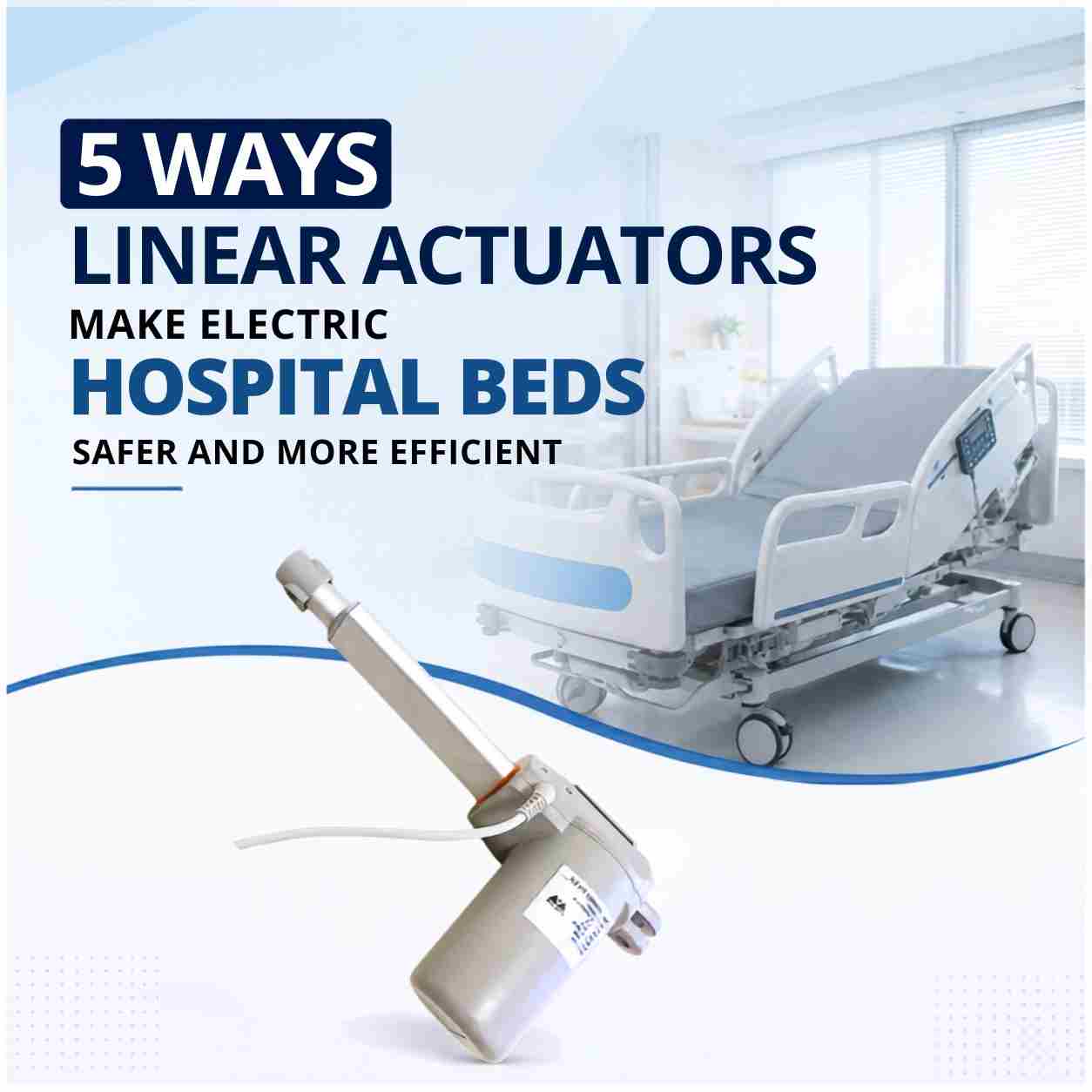
What happens when a hospital bed actuator starts getting unusually hot? A little heat during operation may seem normal, but excessive heat can signal overload, incorrect duty cycle, poor alignment, electrical issues, or an actuator that does not match the bed mechanism. Hospital bed actuators must deliver controlled movement while handling repeated adjustments, so overheating deserves attention before it turns into a bigger reliability problem.
For hospital bed manufacturers, OEMs, and repair teams, understanding the cause matters. Replacing an actuator without identifying the root problem may only provide a temporary fix. Instead, check the complete motion system, from the mechanical load to the actuator control system.
What Causes Hospital Bed Actuators to Overheat?
Several factors can increase actuator temperature. Some relate to the actuator itself, while others come from the bed design, electrical supply, or operating conditions.
1. Excessive Load Can Make the Actuator Work Harder
Every actuator has a defined force capacity. When the applied load approaches or exceeds its working limit, the motor needs to work harder to move the mechanism.
A hospital bed can create additional resistance when the mattress platform, backrest, leg section, or lifting mechanism becomes difficult to move. Friction, worn components, mechanical obstruction, or an incorrectly balanced structure can increase the required force.
The result? Higher motor effort can produce more heat.
What to check:
- Actual load on the actuator
- Mechanical resistance
- Bed-frame movement
- Hinge and pivot condition
- Load distribution
- Any obstruction in the movement path
Do not assume that a higher-force actuator will always solve the problem. First identify why the mechanism requires excessive force.
2. Incorrect Duty Cycle Can Cause Heat Build-Up
One of the most overlooked specifications is duty cycle.
Duty cycle defines how frequently an actuator can operate within a specified period without exceeding its thermal limits. Repeated movement without sufficient rest can prevent the motor from releasing accumulated heat.
For example, Polar Automation lists a 20% duty cycle for one of its hospital bed linear actuator configurations. That specification matters when engineers evaluate how frequently the actuator will operate.
If a bed design requires frequent height, backrest, leg, or tilt adjustments, engineers should evaluate the complete operating pattern rather than looking only at maximum force and stroke.
Prevention: Match the actuator’s duty cycle with the real operating cycle of the hospital bed.
3. The Wrong Hospital Bed Linear Actuator Can Overheat
Not every actuator suits every hospital bed.
Two beds may look similar but have different loads, linkage arrangements, stroke requirements, movement speeds, and operating frequencies. Selecting an actuator only by physical dimensions can create performance problems.
Before selecting hospital bed linear actuators, evaluate:
- Required push and pull force
- Stroke length
- Retracted length
- Operating speed
- Duty cycle
- Voltage
- Mounting points
- Operating temperature
- Control requirements
A current hospital-bed actuator specification can include features such as 24V DC operation, customizable stroke, limit switches, and overload protection. These specifications help engineers match the actuator to the application rather than selecting a unit based on force alone.
4. Voltage Problems Can Increase Motor Stress
Electrical conditions also affect actuator performance.
A hospital bed actuator designed for a particular voltage should receive a suitable and stable supply. Voltage drops, poor connections, undersized wiring, damaged connectors, or an unsuitable power source can affect motor operation.
If the actuator struggles to operate or repeatedly stops under load, inspect the electrical system before replacing the motor.
Check:
- Supply voltage
- Cable condition
- Connector condition
- Power supply capacity
- Loose terminals
- Controller output
- Voltage drop under load
A simple electrical inspection can sometimes identify a problem that initially looks like actuator failure.
5. Poor Alignment Creates Unnecessary Resistance
An actuator can have sufficient force and still overheat if the mounting geometry creates side loading.
Linear actuators work best when the mechanism guides the actuator through the intended direction of travel. Incorrect mounting points, misalignment, damaged brackets, or excessive side force can increase mechanical resistance.
For hospital bed manufacturers, this makes mounting geometry an important part of actuator selection.
When troubleshooting an overheating actuator, check whether the bed mechanism moves freely without the actuator connected, where safe and appropriate. If the mechanism itself feels stiff, replacing the actuator may not solve the underlying issue.
6. Limit Switches and Overload Protection Matter
Modern medical actuator systems can include safety features that help protect the actuator and the connected mechanism.
Limit switches can stop actuator travel at defined end positions. Overload protection can help prevent operation under excessive load conditions. Polar Automation’s hospital bed actuator specifications include both limit switches and overload protection.
However, these features should not replace correct system design.
Engineers should still define appropriate stroke, force, duty cycle, mechanical stops, and control logic. Protection works best when the actuator, controller, and mechanical system operate as one coordinated system.
7. An Inadequate Control System Can Affect Actuator Operation
The actuator is only one part of an electrically operated hospital bed.
A control system determines how the actuator receives commands and manages movement. A suitable controller can regulate actuator operation according to the requirements of the bed.
Linear actuator control systems can manage aspects such as speed, position, and force, while embedded control logic can coordinate actuator movement.
For beds using multiple actuators, coordinated control becomes even more important. Poor control logic or unsuitable switching can cause unnecessary actuator operation, repeated cycling, or inconsistent movement.
For more information, explore this linear actuator control system.
How to Prevent Hospital Bed Actuator Overheating
Prevention starts before the actuator reaches the hospital bed.
Start With the Real Application Load
Do not calculate actuator requirements using only the patient’s weight or the static bed weight. Consider how the bed mechanism distributes load and how the linkage affects actuator force.
Match the Duty Cycle
Record how often each bed function operates during normal use. Then compare that operating pattern with the actuator’s specified duty cycle.
Select the Correct Stroke
An actuator with the wrong stroke can prevent the bed from reaching its intended position or force the mechanism to operate outside its ideal range.
Inspect Mounting and Alignment
Check brackets, pins, joints, linkages, and mounting points during installation and maintenance. Smooth mechanical movement reduces unnecessary actuator stress.
Monitor Electrical Performance
Check voltage under operating conditions instead of checking only the unloaded power supply. Inspect connectors and cables for damage, looseness, or excessive resistance.
Use Appropriate Protection
Limit switches, overload protection, and suitable actuator control logic can help protect the system when properly designed and configured.
When Should You Replace an Overheating Actuator?
Overheating does not automatically mean that the actuator needs replacement.
First, identify whether the problem comes from the actuator or the surrounding system. Check load, mechanical resistance, duty cycle, electrical supply, alignment, and control signals.
If the actuator continues to overheat after you correct external causes, inspect it for internal wear or damage. Repeated overheating can indicate motor, gearbox, screw, bearing, or electrical problems.
For hospital bed repair companies, this approach can prevent unnecessary replacement and help identify recurring system-level problems.
Final Takeaway
Hospital bed actuators overheat for a reason. Excessive load, incorrect duty cycle, poor alignment, electrical problems, unsuitable actuator selection, and inadequate control can all increase thermal stress.
The solution starts with diagnosis, not replacement.
For manufacturers, specify the actuator according to the complete bed mechanism. For repair teams, inspect the mechanical and electrical system before changing the actuator. For OEMs, evaluate actuator and control-system compatibility during the design stage.
If you are designing or upgrading a hospital bed motion system, review the required load, stroke, speed, duty cycle, mounting arrangement, voltage, and control requirements before finalizing the actuator.
To explore actuator specifications and application options, see the Hospital Bed Linear Actuator page and evaluate the requirements of your specific bed design.
The right actuator is not simply the strongest one. It is the one correctly matched to the complete application.