Why Hospital Bed Actuators Overheat? 7 Causes and How to Prevent It

What happens when a hospital bed actuator starts getting unusually hot? A little heat during operation may seem normal, but excessive heat can signal overload, incorrect duty cycle, poor alignment, electrical issues, or an actuator that does not match the bed mechanism. Hospital bed actuators must deliver controlled movement while handling repeated adjustments, so overheating deserves attention before it turns into a bigger reliability problem.

For hospital bed manufacturers, OEMs, and repair teams, understanding the cause matters. Replacing an actuator without identifying the root problem may only provide a temporary fix. Instead, check the complete motion system, from the mechanical load to the actuator control system.

What Causes Hospital Bed Actuators to Overheat?


Several factors can increase actuator temperature. Some relate to the actuator itself, while others come from the bed design, electrical supply, or operating conditions.

1. Excessive Load Can Make the Actuator Work Harder


Every actuator has a defined force capacity. When the applied load approaches or exceeds its working limit, the motor needs to work harder to move the mechanism.

A hospital bed can create additional resistance when the mattress platform, backrest, leg section, or lifting mechanism becomes difficult to move. Friction, worn components, mechanical obstruction, or an incorrectly balanced structure can increase the required force.

The result? Higher motor effort can produce more heat.

What to check:

  • Actual load on the actuator
  • Mechanical resistance
  • Bed-frame movement
  • Hinge and pivot condition
  • Load distribution
  • Any obstruction in the movement path

Do not assume that a higher-force actuator will always solve the problem. First identify why the mechanism requires excessive force.

2. Incorrect Duty Cycle Can Cause Heat Build-Up


One of the most overlooked specifications is duty cycle.

Duty cycle defines how frequently an actuator can operate within a specified period without exceeding its thermal limits. Repeated movement without sufficient rest can prevent the motor from releasing accumulated heat.

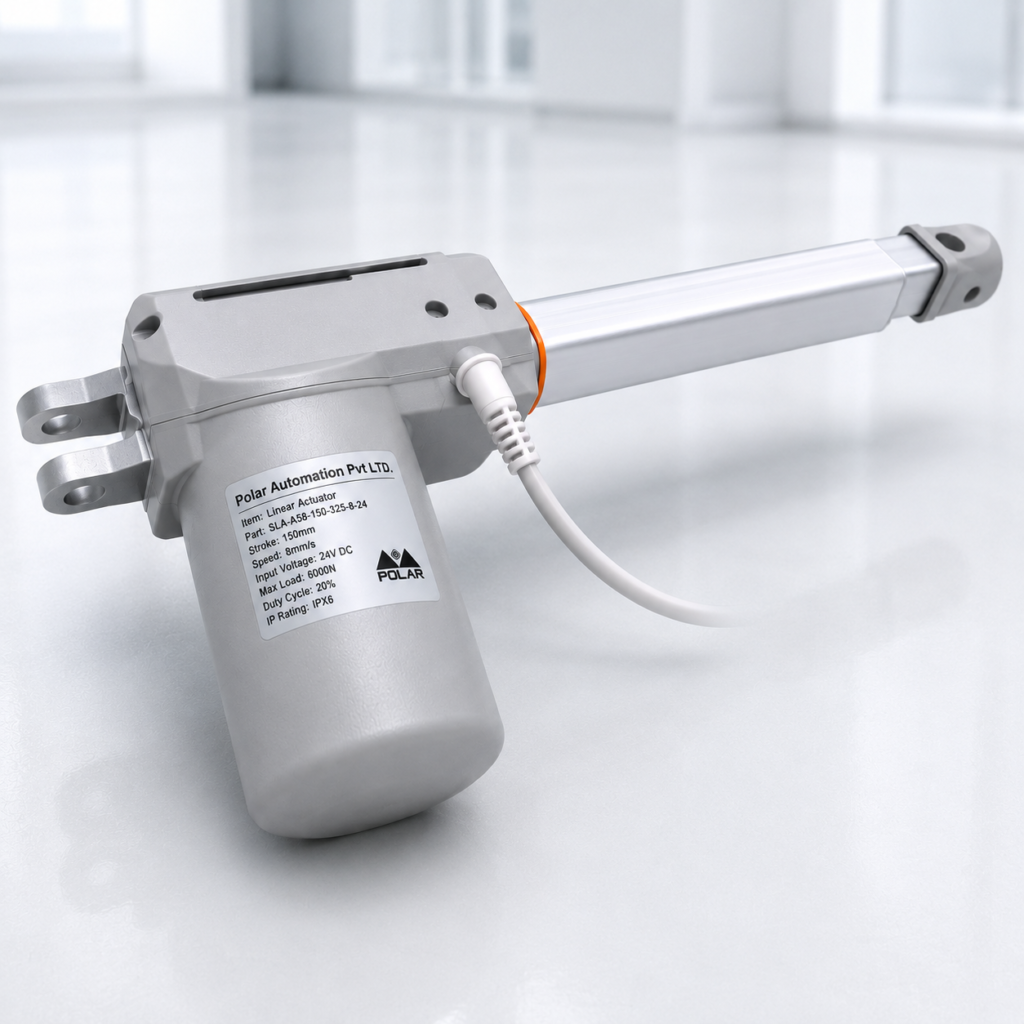
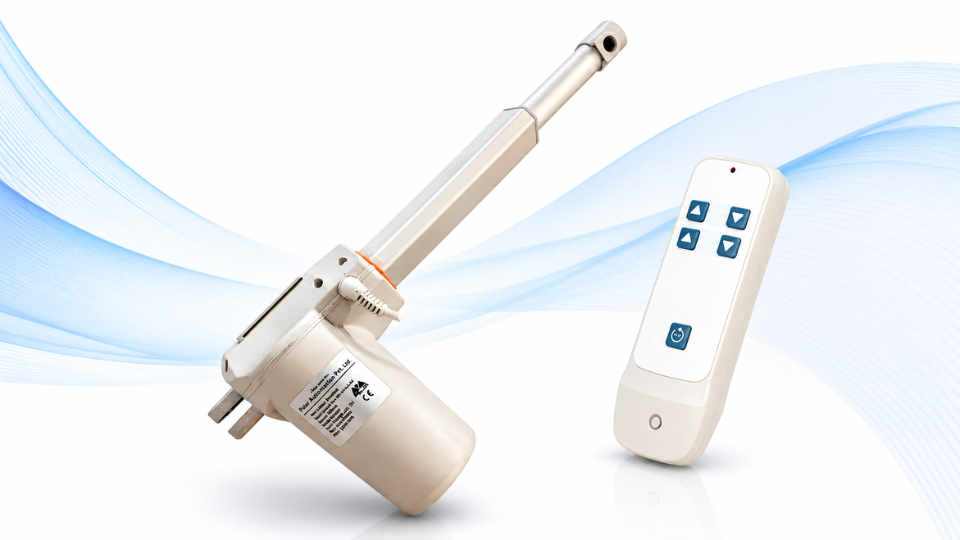
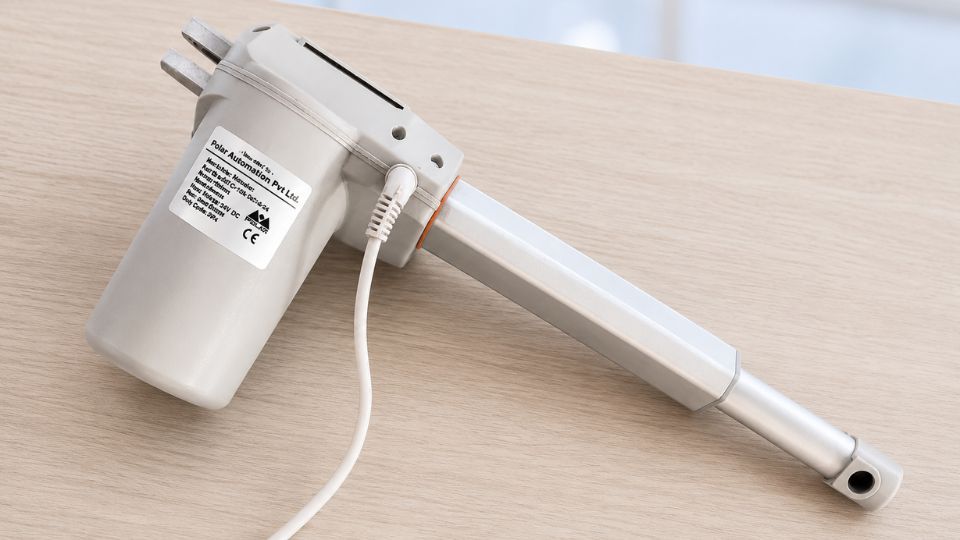
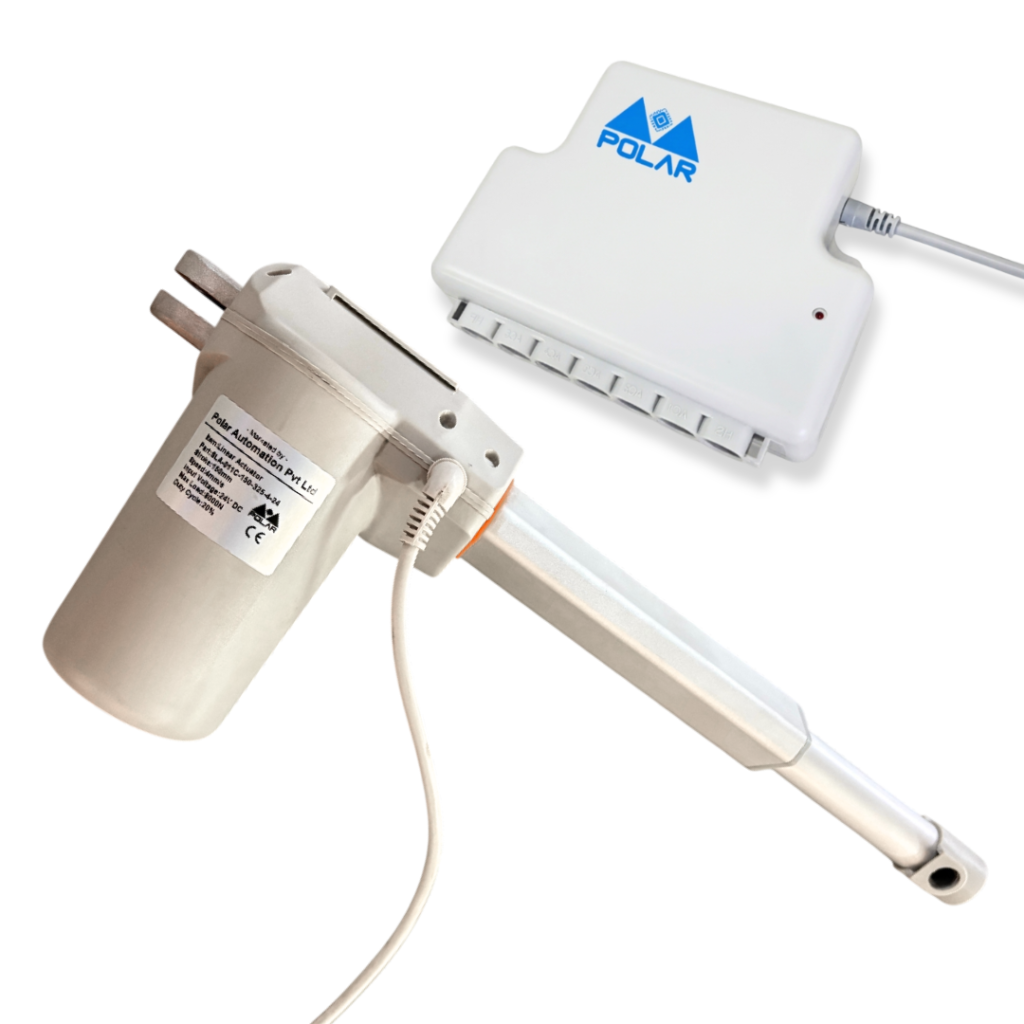
For example, Polar Automation lists a 20% duty cycle for one of its hospital bed linear actuator configurations. That specification matters when engineers evaluate how frequently the actuator will operate.

If a bed design requires frequent height, backrest, leg, or tilt adjustments, engineers should evaluate the complete operating pattern rather than looking only at maximum force and stroke.

Prevention: Match the actuator’s duty cycle with the real operating cycle of the hospital bed.

3. The Wrong Hospital Bed Linear Actuator Can Overheat


Not every actuator suits every hospital bed.

Two beds may look similar but have different loads, linkage arrangements, stroke requirements, movement speeds, and operating frequencies. Selecting an actuator only by physical dimensions can create performance problems.

Before selecting hospital bed linear actuators, evaluate:

  • Required push and pull force
  • Stroke length
  • Retracted length
  • Operating speed
  • Duty cycle
  • Voltage
  • Mounting points
  • Operating temperature
  • Control requirements

A current hospital-bed actuator specification can include features such as 24V DC operation, customizable stroke, limit switches, and overload protection. These specifications help engineers match the actuator to the application rather than selecting a unit based on force alone.

4. Voltage Problems Can Increase Motor Stress


Electrical conditions also affect actuator performance.

A hospital bed actuator designed for a particular voltage should receive a suitable and stable supply. Voltage drops, poor connections, undersized wiring, damaged connectors, or an unsuitable power source can affect motor operation.

If the actuator struggles to operate or repeatedly stops under load, inspect the electrical system before replacing the motor.

Check:

  • Supply voltage
  • Cable condition
  • Connector condition
  • Power supply capacity
  • Loose terminals
  • Controller output
  • Voltage drop under load

A simple electrical inspection can sometimes identify a problem that initially looks like actuator failure.

5. Poor Alignment Creates Unnecessary Resistance


An actuator can have sufficient force and still overheat if the mounting geometry creates side loading.

Linear actuators work best when the mechanism guides the actuator through the intended direction of travel. Incorrect mounting points, misalignment, damaged brackets, or excessive side force can increase mechanical resistance.

For hospital bed manufacturers, this makes mounting geometry an important part of actuator selection.

When troubleshooting an overheating actuator, check whether the bed mechanism moves freely without the actuator connected, where safe and appropriate. If the mechanism itself feels stiff, replacing the actuator may not solve the underlying issue.

6. Limit Switches and Overload Protection Matter


Modern medical actuator systems can include safety features that help protect the actuator and the connected mechanism.

Limit switches can stop actuator travel at defined end positions. Overload protection can help prevent operation under excessive load conditions. Polar Automation’s hospital bed actuator specifications include both limit switches and overload protection.

However, these features should not replace correct system design.

Engineers should still define appropriate stroke, force, duty cycle, mechanical stops, and control logic. Protection works best when the actuator, controller, and mechanical system operate as one coordinated system.

7. An Inadequate Control System Can Affect Actuator Operation


The actuator is only one part of an electrically operated hospital bed.

A control system determines how the actuator receives commands and manages movement. A suitable controller can regulate actuator operation according to the requirements of the bed.

Linear actuator control systems can manage aspects such as speed, position, and force, while embedded control logic can coordinate actuator movement.

For beds using multiple actuators, coordinated control becomes even more important. Poor control logic or unsuitable switching can cause unnecessary actuator operation, repeated cycling, or inconsistent movement.

For more information, explore this linear actuator control system.

How to Prevent Hospital Bed Actuator Overheating


 Prevention starts before the actuator reaches the hospital bed.

Start With the Real Application Load

Do not calculate actuator requirements using only the patient’s weight or the static bed weight. Consider how the bed mechanism distributes load and how the linkage affects actuator force.

Match the Duty Cycle

Record how often each bed function operates during normal use. Then compare that operating pattern with the actuator’s specified duty cycle.

Select the Correct Stroke

An actuator with the wrong stroke can prevent the bed from reaching its intended position or force the mechanism to operate outside its ideal range.

Inspect Mounting and Alignment

Check brackets, pins, joints, linkages, and mounting points during installation and maintenance. Smooth mechanical movement reduces unnecessary actuator stress.

Monitor Electrical Performance

Check voltage under operating conditions instead of checking only the unloaded power supply. Inspect connectors and cables for damage, looseness, or excessive resistance.

Use Appropriate Protection

Limit switches, overload protection, and suitable actuator control logic can help protect the system when properly designed and configured.

When Should You Replace an Overheating Actuator?


Overheating does not automatically mean that the actuator needs replacement.

First, identify whether the problem comes from the actuator or the surrounding system. Check load, mechanical resistance, duty cycle, electrical supply, alignment, and control signals.

If the actuator continues to overheat after you correct external causes, inspect it for internal wear or damage. Repeated overheating can indicate motor, gearbox, screw, bearing, or electrical problems.

For hospital bed repair companies, this approach can prevent unnecessary replacement and help identify recurring system-level problems.

Final Takeaway


Hospital bed actuators overheat for a reason. Excessive load, incorrect duty cycle, poor alignment, electrical problems, unsuitable actuator selection, and inadequate control can all increase thermal stress.

The solution starts with diagnosis, not replacement.

For manufacturers, specify the actuator according to the complete bed mechanism. For repair teams, inspect the mechanical and electrical system before changing the actuator. For OEMs, evaluate actuator and control-system compatibility during the design stage.

If you are designing or upgrading a hospital bed motion system, review the required load, stroke, speed, duty cycle, mounting arrangement, voltage, and control requirements before finalizing the actuator.

To explore actuator specifications and application options, see the Hospital Bed Linear Actuator page and evaluate the requirements of your specific bed design.

The right actuator is not simply the strongest one. It is the one correctly matched to the complete application.
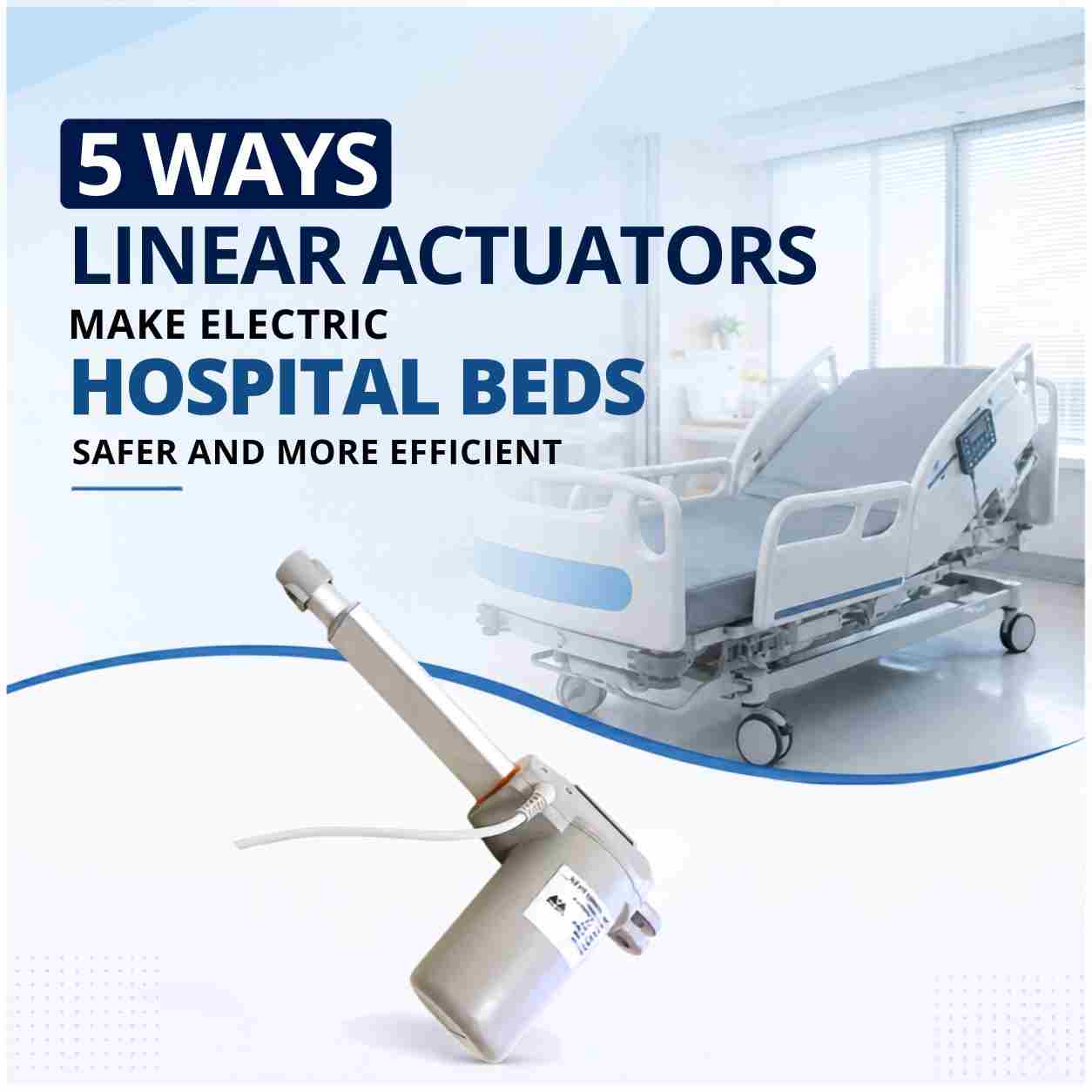
5 Ways Linear Actuators Make Electric Hospital Beds Safer and More Efficient​

Linear Actuators


What happens when a hospital bed needs to move a patient quickly, safely, and precisely? Manual mechanisms can slow down caregivers and make positioning harder. That is why modern electric hospital beds rely on Linear Actuators for controlled movement.

From raising the bed height to adjusting the backrest, leg section, and tilt, Linear Actuators help turn simple electrical commands into smooth mechanical movement. When combined with an intelligent control system, they can also support safer operation and multiple bed functions.

But what makes Linear Actuators so important for modern hospital beds? Here are five key ways they improve safety, efficiency, and overall bed performance.


What Are Linear Actuators?


Linear Actuators are electromechanical devices that convert rotary motion from an electric motor into controlled linear movement. In simple terms, they push or pull a connected part to move it into the required position.

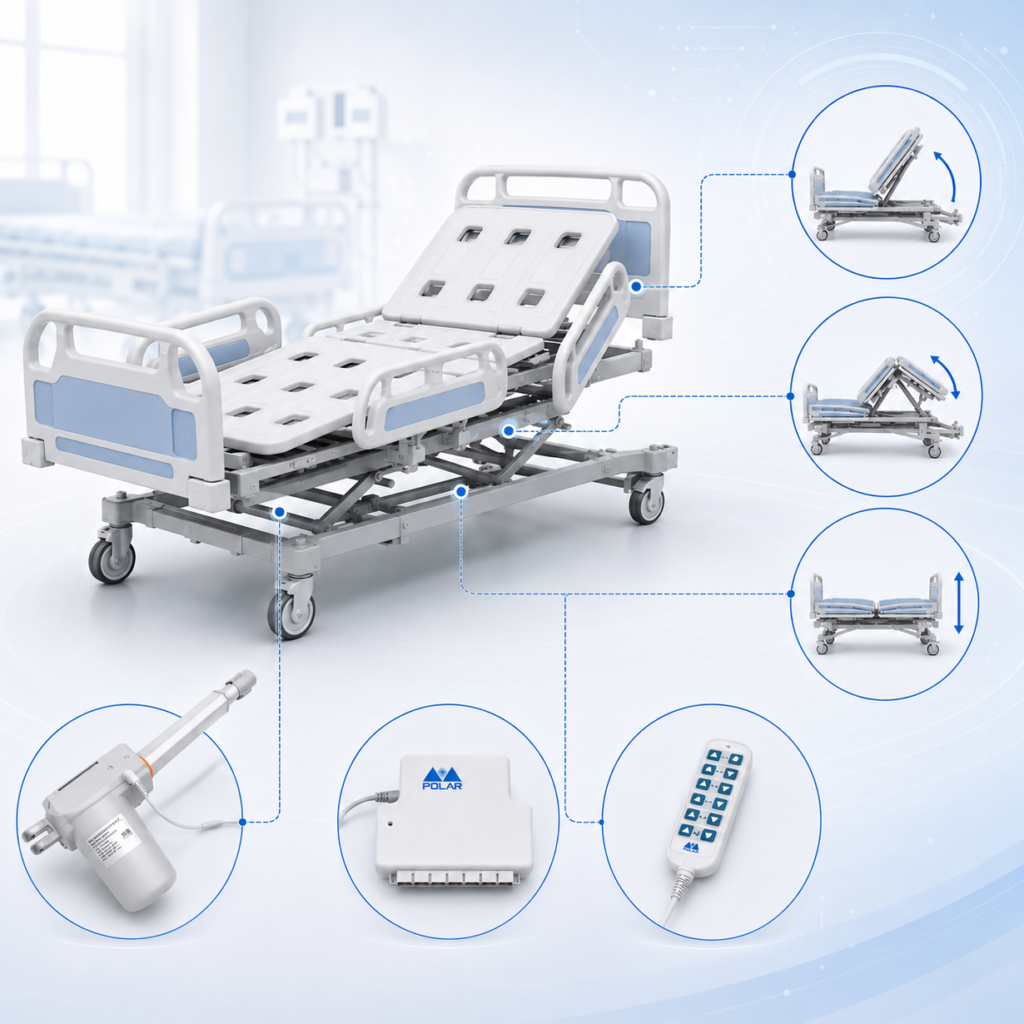
In hospital beds, Linear Actuators can control different sections of the bed. For example, one actuator can raise the backrest while another adjusts the leg section. A separate actuator can control the overall bed height.

This allows patients and caregivers to change the bed position with a simple control command.

1. Linear Actuators Provide Precise Bed Positioning


Patient positioning plays an important role in hospital care. A bed may need to move into different positions during examination, treatment, recovery, or daily care.

Linear Actuators provide controlled movement for these adjustments. The motor moves the actuator shaft, which then changes the position of the connected bed section.

This precise movement can help achieve positions such as:

  • Raised or lowered bed height
  • Adjustable backrest
  • Raised or lowered leg section
  • Tilted bed position
  • Trendelenburg position
  • Reverse Trendelenburg position

A well-designed actuator system also allows the movement to stop at the required position. This gives patients and caregivers better control over the bed.

For OEMs, precise positioning also makes it easier to develop beds with multiple functions without adding complex mechanical systems.


2. Linear Actuators Reduce Manual Effort


Moving a hospital bed manually can require significant physical effort. Caregivers may need to adjust the patient’s position several times during a shift.

Electric Linear Actuators reduce this workload by handling the movement through motorized operation.

With a suitable control system, the caregiver can select the required function using a hand control, nurse control panel, or other interface. The actuator then moves the bed section smoothly.

This can save time during routine activities such as:

  • Patient repositioning
  • Bed height adjustment
  • Clinical examination
  • Patient transfer
  • Nursing procedures
  • Comfort adjustments

Reducing manual movement can also help caregivers focus more on patient care instead of mechanical bed adjustments.

3. Linear Actuators Support Safer Patient Movement


Safety becomes critical when a hospital bed moves while a patient is lying on it. Sudden or uncontrolled movement can create unnecessary risks.

Modern Linear Actuators in hospital bed systems can work with electronic control units that manage actuator movement and system limits.

For example, a control system can coordinate several actuators instead of operating each motor independently. This helps the bed perform complex movements in a controlled sequence.

Safety-focused actuator control can also support functions such as:

  • Emergency flat or CPR positioning
  • Controlled stopping
  • Movement limits
  • Coordinated actuator operation
  • Protection against conflicting commands

The actuator itself provides the mechanical movement. The control system determines how and when that movement occurs.

This combination is important for modern electric hospital bed designs.

4. Multiple Linear Actuators Enable More Bed Functions


One of the biggest advantages of using Linear Actuators is scalability.

A basic electric bed may only require a small number of movement functions. However, advanced hospital beds can require several independent adjustments.

For example, a multi-function bed can use separate actuator channels for:

Height + Backrest + Leg Section + Tilt + Trendelenburg

Each function can operate through its own actuator while the control system coordinates the complete system.

This approach gives medical equipment manufacturers more flexibility when developing different bed models.

Instead of redesigning the complete mechanical system for every model, manufacturers can create different configurations around a modular actuator and control architecture.

That can simplify product development and help OEMs build beds with different levels of functionality.

5. Linear Actuators Improve Operational Efficiency


Efficiency is not only about speed. It also involves reliability, simplified installation, reduced wiring, and easier system integration.

A properly designed actuator system can help OEMs create cleaner and more organized hospital bed designs.

Modern control architectures can coordinate several actuators through a central control unit. This reduces the need for complicated individual control arrangements.

For manufacturers, this can provide benefits such as:

  • Simplified system integration
  • Cleaner wiring architecture
  • Easier assembly
  • Coordinated movement
  • Flexible bed configurations
  • Better user control

For hospitals, efficient bed operation can support smoother workflows for caregivers.

The result is a system that combines mechanical movement with intelligent electronic control.

Why Actuator Control Matters as Much as the Actuator


Choosing the right Linear Actuator is only one part of designing an electric hospital bed.

The actuator needs a suitable control system to perform reliably. The controller manages inputs from the hand control, nurse panel, or other interfaces and sends the appropriate commands to the actuators.

A multi-function hospital bed may need to coordinate several motors at the same time. The control system therefore becomes an important part of the overall architecture.

For example, an advanced actuator control system can coordinate multiple functions while supporting safety responses such as emergency positioning.

This is especially important for beds that use four or more actuators.

How to Choose Linear Actuators for Hospital Beds


OEMs should consider several factors before selecting Linear Actuators for a medical bed.

Load Capacity

The actuator must support the required load without compromising movement or reliability. Consider the patient weight, mattress, bed structure, and dynamic loads.

Stroke Length

Stroke determines how far the actuator can extend or retract. The correct stroke depends on the required range of bed movement.

Speed

Actuator speed affects how quickly the bed reaches the desired position. However, higher speed should not come at the expense of controlled movement.

Duty Cycle

Hospital beds may perform repeated adjustments throughout the day. The actuator should match the expected operating cycle.

Noise Level

Low operating noise can improve the patient experience, especially in hospitals and care environments where quiet operation matters.

Safety and Integration

The actuator should work effectively with the selected control box and user interface. Mechanical limits, electrical protection, and coordinated control all contribute to system safety.


The Future of Linear Actuators in Hospital Beds


Hospital bed technology continues to move toward smarter and more integrated designs. Linear Actuators will remain important because they provide the physical movement required by these systems.

Future designs may place greater emphasis on intelligent control, easier integration, wireless communication, improved diagnostics, and more responsive safety functions.

For OEMs, this means actuator selection should not happen in isolation. The actuator, control box, handset, sensors, and software logic should work together as one system.

This integrated approach can help manufacturers create beds that are easier to operate, assemble, maintain, and customize.

Conclusion


Linear Actuators have become an important part of modern electric hospital beds. They provide controlled movement, reduce manual effort, support safer patient positioning, enable multiple bed functions, and improve overall operating efficiency.

However, the actuator is only one part of the solution. A reliable control system must coordinate the actuators and manage bed functions safely.

For medical equipment OEMs, the right combination of Linear Actuators and intelligent actuator control can create a more flexible and efficient hospital bed platform.

If you are developing an electric hospital bed and need a suitable actuator and control solution, explore Polar Automation’s Hospital Bed Linear Actuator solutions for medical applications.

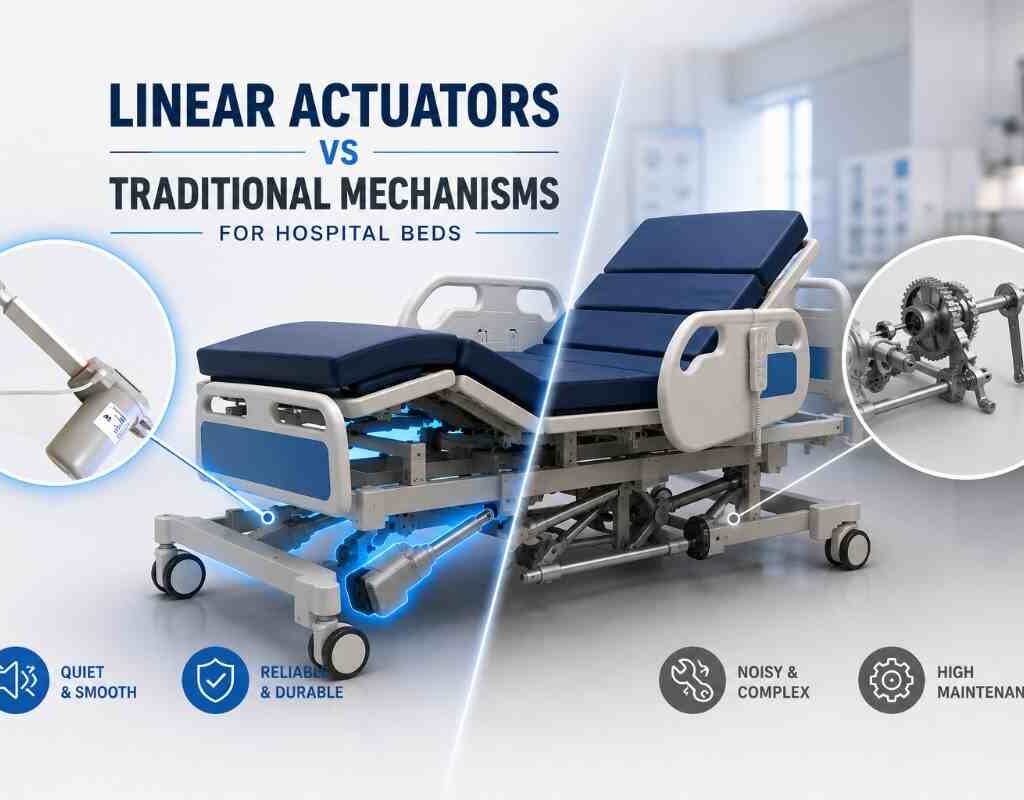
Linear Actuators vs Traditional Mechanisms for Hospital Beds

linear actuator


Modern hospital beds need Linear Actuators to do much more than support a patient. They must provide smooth positioning, reliable movement, easy operation, and dependable performance. As a result, hospital bed manufacturers are moving toward electrically adjustable designs that can support multiple bed functions.

One of the key technologies behind this movement is Linear Actuators. These systems convert electrical energy into controlled linear motion. They can adjust the backrest, leg section, bed height, tilt, and other positions with accuracy.

However, traditional mechanical mechanisms still have a place in some bed designs. So, which approach is better for modern hospital beds?

The answer depends on the bed design, required functions, operating environment, and user expectations. Still, for many modern electric hospital beds, linear actuator-based systems offer clear advantages.

What Are Linear Actuators?


A linear actuator is a device that creates controlled movement along a straight line. In an electric hospital bed, the actuator can move a specific section of the bed when the user presses a button or activates a control.

For example, one actuator can raise or lower the backrest. Another can adjust the leg section. Additional actuators can control bed height, tilt, or other movements.

The actuator works as part of a larger system. A typical setup can include the actuator, control box, hand controller, and safety functions. Together, these components allow the bed to deliver controlled and repeatable movement.

Because of this, linear actuators have become an important part of modern adjustable hospital beds.

What Are Traditional Hospital Bed Mechanisms?


Traditional mechanisms use mechanical components such as levers, linkages, gears, springs, shafts, or manually operated adjustment systems.

These mechanisms can provide basic bed positioning without relying on an electric motor. In some applications, that simplicity can be useful.

For example, a manually adjustable bed may work well where only a few basic positions are required. It can also reduce dependence on electrical components.

However, as hospital beds become more advanced, mechanical systems can become more complicated. Multiple functions may require additional linkages and components. Consequently, achieving smooth and independent movement can become more challenging.

Linear Actuators vs. Traditional Mechanisms: Key Differences


The biggest difference comes down to how the bed creates and controls movement.

Traditional mechanisms rely mainly on mechanical force and manual operation. In contrast, linear actuators use an electric motor and mechanical drive system to produce controlled movement.

This difference affects several important areas.

1. Movement and Position Control

Modern hospital beds often require precise positioning. Healthcare professionals may need to adjust the backrest or leg section to a specific position. Patients may also need frequent position changes for comfort and care.

With linear actuators, each movement can be controlled through a suitable control system. The actuator moves according to the input from the hand controller or bed control interface.

Traditional mechanisms, on the other hand, depend more heavily on manual adjustment. Therefore, achieving consistent positioning can be less convenient.

For beds with multiple adjustable functions, electric actuation offers a more practical approach.

2. Patient and Caregiver Convenience

Ease of operation matters in a hospital environment.

With an electric system, a caregiver can adjust the bed using a hand controller or integrated control panel. The patient may also operate certain functions without requiring manual assistance.

By comparison, traditional mechanisms may require physical effort. The user might need to operate a lever, rotate a handle, or manually adjust a section of the bed.

Therefore, linear actuator-based systems can improve convenience for both patients and caregivers.

3. Multiple Bed Functions

A modern hospital bed may support several functions, including:

  • Backrest adjustment

  • Leg section adjustment

  • Height adjustment

  • Trendelenburg positioning

  • Reverse Trendelenburg positioning

  • Bed tilt

Managing several functions with traditional mechanical mechanisms can require a complex arrangement of components.

Linear actuators provide a more flexible way to control individual movements. For instance, a multi-function control system can coordinate several actuators and provide dedicated control for different bed positions.

As a result, actuator-based designs are well suited to advanced electric hospital beds.

4. Smooth and Controlled Movement

Hospital bed movement should be stable and controlled. Sudden or inconsistent movement can affect patient comfort and overall usability.

A properly selected actuator can provide controlled movement at a suitable speed. The control system can also coordinate actuator operation according to the bed’s design requirements.

Traditional mechanical systems can provide reliable movement as well. However, their performance depends heavily on mechanical design, adjustment, and the condition of individual components.

Over time, wear in mechanical parts may also affect movement quality.

5. Safety and Control

Safety is another important consideration for hospital bed manufacturers.

Electric hospital beds can integrate actuator movement with control logic and safety functions. For example, a control system can manage multiple actuators and respond to specific operating conditions.

Emergency functions can also be incorporated into suitable actuator control systems. In critical situations, the bed can support predefined movements such as an emergency flat or CPR position, depending on the system design.

Traditional mechanisms can also be designed with safety in mind. However, adding advanced electronic control and coordinated movement is naturally more difficult when the system depends primarily on manual mechanical operation.

6. Design Flexibility for OEMs

Hospital bed manufacturers need flexibility when developing different models.

An OEM may want to create a basic adjustable bed for one market and a more advanced multi-function model for another. The actuator and control system can be selected according to the required functions, load conditions, stroke length, speed, and installation space.

This flexibility makes electric actuation suitable for different hospital bed configurations.

Moreover, integrated control systems can help reduce unnecessary wiring and simplify system integration when designed specifically for the application.

Are Traditional Mechanisms Still Useful?


Yes. Traditional mechanisms are not automatically outdated.

They can still make sense for basic beds where electrical adjustment is not required. They may also suit applications where simplicity, manual operation, or lower system complexity is the priority.

However, the requirements change when the bed needs several adjustable functions.

For modern hospital beds, users increasingly expect easy operation and smooth positioning. At the same time, OEMs need reliable systems that can integrate with the overall bed design. Therefore, electric actuation often becomes the more practical solution.

Why Linear Actuators Suit Modern Hospital Beds


The main advantage is not simply that an actuator moves the bed. The real benefit comes from controlled, repeatable, and electrically managed movement.

A well-designed actuator system can help manufacturers create beds that are easier to operate and more adaptable to different care requirements.

Furthermore, actuators can work together with dedicated control systems to manage several bed functions. This combination creates a complete motion-control solution rather than an isolated mechanical component.

For hospital bed OEMs, that distinction is important.

The right solution should consider more than actuator specifications alone. Load capacity, stroke length, speed, duty cycle, installation space, noise, safety requirements, and control compatibility all need careful evaluation.

Linear Actuators or Traditional Mechanisms: Which Should You Choose?


There is no single solution for every hospital bed.

If the design requires basic manual adjustment, a traditional mechanism may still be suitable. However, if the bed requires multiple functions, easy operation, precise movement, and integrated control, linear actuators offer significant advantages.

In particular, electric hospital beds with three, five, or more functions can benefit from coordinated actuator control.

Therefore, the better choice depends on the intended application. For modern, multi-function hospital beds, however, linear actuator-based systems provide a strong foundation for reliable and convenient movement.

Conclusion


Hospital bed technology continues to evolve. As beds become more adjustable and user-focused, the need for reliable motion-control systems also increases.

Traditional mechanisms remain useful for simple applications. However, Linear Actuators offer greater flexibility for modern electric hospital beds that require multiple controlled movements.

They can support smoother positioning, easier operation, flexible bed configurations, and integration with dedicated control systems.

For OEMs and medical equipment manufacturers, the key is to select an actuator and control solution that matches the bed’s functional and safety requirements. When these components are designed to work together, they can create a more reliable and user-friendly hospital bed.

Ultimately, the goal is not simply to move the bed. It is to create controlled movement that supports better usability, efficient operation, and modern patient-care requirements.

Linear Actuators for Solar Panels: The Key to Automated Positioning

Linear actuators for solar panels
 
Solar energy has become an important part of the shift toward cleaner and more sustainable power. However, installing solar panels is only one part of the equation. The way panels are positioned can also affect how effectively they receive sunlight throughout the day.
Traditional fixed solar panel structures keep panels at one angle. This approach works well for many installations, but it does not allow the panel to adjust as the sun changes position. An adjustable solar panel stand offers a smarter alternative. It can change the panel angle to improve sunlight exposure, and linear actuators for solar panels provide a reliable way to create this controlled movement.
With precise linear motion, compact design, and easy integration with control systems, linear actuators can help solar manufacturers and system integrators develop more flexible and automated solar mounting solutions.

Why Adjustable Solar Panel Stands Matter

 
The sun does not stay in one position throughout the day. Its angle changes from morning to evening and varies across seasons. As a result, a fixed panel position may not always provide the best orientation toward the sun.
An adjustable solar panel stand can respond to these changes by moving the panel to a preferred angle. This movement can support better solar exposure and make the mounting structure more adaptable to different operating conditions.
For example, a system can adjust the panel angle at selected times during the day. A controller can also coordinate movement based on programmed positions or sensor inputs. This creates a more responsive solar mounting system without requiring manual adjustment.
The challenge is finding a compact and dependable mechanism that can deliver controlled movement. This is where linear actuators become valuable.

What Is a Linear Actuator?

 
A linear actuator is a device that converts rotational motion into controlled linear movement. Depending on the design, it can extend or retract a rod to move a connected structure.
In a solar mounting application, the actuator can connect between the mounting frame and the supporting structure. When the actuator extends or retracts, it changes the angle of the solar panel.
The concept is simple, but the actuator plays an important role in controlling the physical movement of the system.
An electric linear actuator can also work with switches, timers, sensors, PLCs, or other control electronics. This flexibility makes it suitable for automated solar positioning applications where controlled and repeatable movement matters.

How Linear Actuators Work in Solar Panel Positioning

 
A typical adjustable solar panel system combines several components. These may include the solar panel frame, mounting structure, actuator, controller, power supply, and positioning or control mechanism.
The controller determines when the panel needs to move. It then sends a signal to the actuator. The actuator extends or retracts according to the required movement, which changes the panel’s angle.
Once the desired position is reached, the actuator can stop. The controller can repeat this process at different intervals or respond to changing input conditions.
For example, a solar system may use programmed movement throughout the day:
Morning → Midday Position → Afternoon Position → Evening Position
This approach allows the mounting system to make controlled adjustments rather than relying on manual positioning.

Key Benefits of Linear Actuators for Solar Panels


1. Precise Movement

Solar panel positioning often requires controlled movement rather than sudden or uncontrolled changes. Linear actuators can provide consistent extension and retraction, allowing the system designer to control the movement of the panel.
This makes them useful for applications where accurate positioning is important.

2. Easy System Integration

Linear actuators can integrate with different control systems. Depending on the application, the actuator can work with switches, timers, sensors, PLCs, or dedicated electronic controllers.
This allows manufacturers to develop solutions ranging from simple adjustable stands to fully automated solar positioning systems.

3. Compact and Practical Design

Space can be an important consideration in solar mounting systems. A compact actuator can provide the required linear movement without adding a complex mechanical arrangement.
Its straightforward installation can also simplify the overall mechanical design.

4. Controlled and Repeatable Operation

An automated solar mounting system may need to perform the same movement repeatedly. A suitable linear actuator can support consistent operation over multiple adjustment cycles.
This repeatability helps create a predictable positioning system and reduces the need for manual intervention.

5. Reduced Manual Adjustment

Manual adjustment can become inconvenient, especially when solar panels are installed at height or across a large area. Automation allows the system to make scheduled or controlled adjustments without requiring an operator to physically reposition the panel.
Linear Actuator for solar panel

Choosing the Right Linear Actuator for a Solar Application

 
Not every actuator will suit every solar mounting system. The actuator should match the mechanical and environmental requirements of the application.
Load capacity is one of the first factors to consider. The actuator must handle the force required to move the panel and mounting structure safely.
Stroke length also matters. It determines how far the actuator can extend or retract and therefore affects the available adjustment range.
Speed is another consideration. The required movement speed depends on the panel size, mounting design, and control strategy. Solar positioning usually focuses on controlled movement rather than very high speed.
The operating environment also deserves attention. Outdoor solar installations can expose equipment to dust, moisture, temperature changes, and other environmental conditions. Therefore, the actuator’s construction and protection level should match the installation environment.
Finally, consider duty cycle, mounting arrangement, power requirements, and control compatibility before selecting an actuator.

Where Adjustable Solar Panel Stands Can Be Used

 
Adjustable solar panel systems can support a wide range of applications. They can be considered for residential solar installations, commercial rooftops, solar farms, agricultural systems, remote power installations, and specialized solar equipment.
They can also benefit applications where the available installation space requires flexible panel positioning.
For OEMs and system integrators, actuator-based designs provide an opportunity to develop customized solar mounting solutions around specific panel dimensions, movement requirements, and control systems.

Why Actuator Selection Matters

 
The actuator may look like a small part of a solar mounting system, but its performance can influence the reliability of the complete mechanism.
An actuator with unsuitable force, stroke, speed, or environmental protection can affect system performance. On the other hand, the right actuator can provide smooth and dependable movement while simplifying mechanical integration.
For this reason, actuator selection should begin with the complete application. Panel weight, mounting geometry, required movement, installation conditions, power supply, and control method should all be considered together.
The Future of Automated Solar Positioning

 
Solar technology continues to move toward smarter and more automated systems. As automation becomes more accessible, adjustable mounting solutions can offer manufacturers new ways to improve flexibility and control.
Linear actuators provide a practical connection between electronic control and mechanical movement. A controller can make a decision, while the actuator performs the physical adjustment.
This combination makes linear actuator technology useful for developing modern solar positioning systems that require reliable, controlled movement.

Conclusion

 
An adjustable solar panel stand can provide greater flexibility than a fixed mounting structure, especially when the application requires controlled changes in panel angle. Linear actuators for solar panels offer a practical way to create this movement.
From precise positioning and easy control integration to reduced manual adjustment, linear actuators can support the development of smarter solar mounting systems. However, choosing the right actuator requires careful consideration of load, stroke, speed, duty cycle, environmental conditions, and installation requirements.
For OEMs, solar equipment manufacturers, and system integrators, the right linear actuator can turn a basic adjustable structure into a reliable automated positioning solution. As solar systems continue to evolve, controlled linear motion will remain an important part of building smarter and more adaptable solar technologies.
Polar Automation develops linear actuator solutions designed for applications that require reliable and controlled motion. With the right actuator and control approach, solar manufacturers can create adjustable panel systems that are practical, efficient, and ready for automation.

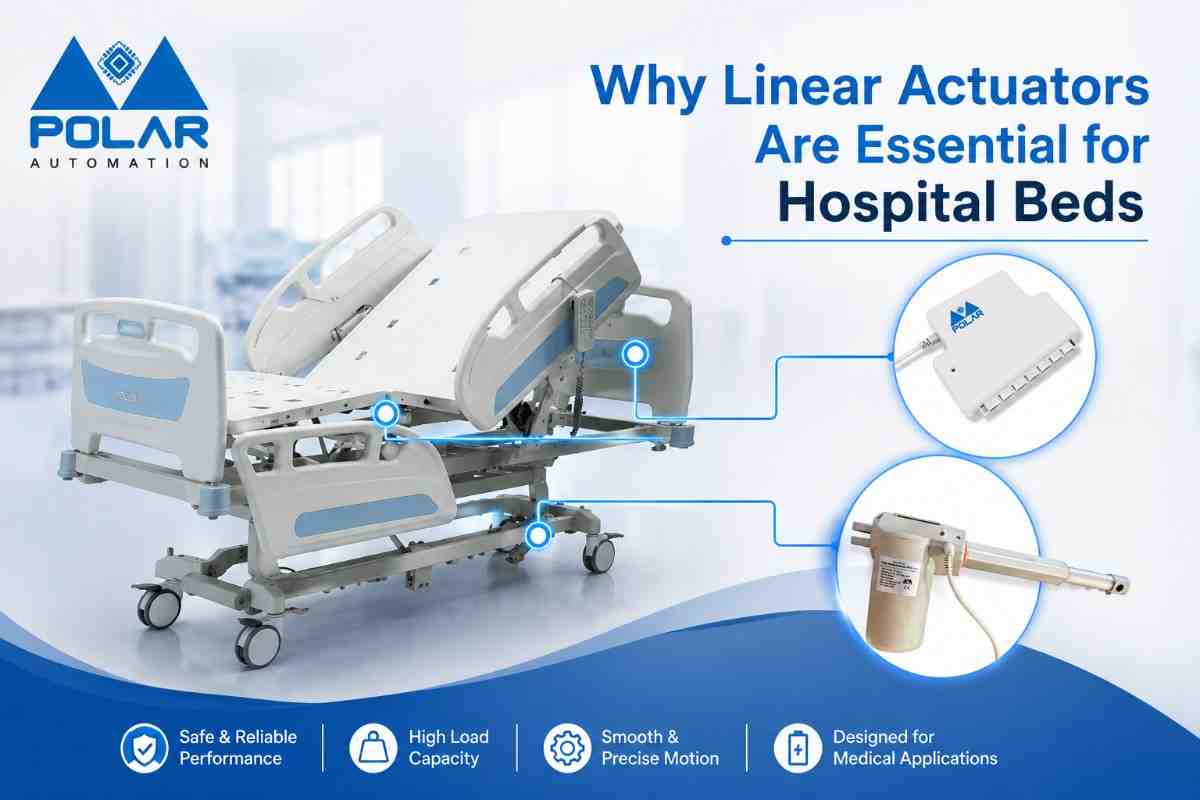
Why Linear Actuators Are Essential for Hospital Beds

Introduction

Modern hospital beds do much more than provide a place for patients to rest. Linear actuators for hospital beds play a key role in making these functions possible. They help healthcare professionals position patients safely, improve comfort, and perform routine care with less physical effort.

A linear actuator converts electrical energy into controlled linear movement. In a hospital bed, it can raise the bed, adjust the backrest, move the leg section, or tilt the complete bed platform. Multiple actuators can also work together through a hospital bed actuator control system to create several independent bed functions.

As hospitals and medical equipment manufacturers demand safer and more flexible patient-care solutions, reliable linear actuator systems have become an important part of modern electric hospital bed design.

A linear actuator is an electromechanical device that creates straight-line movement. Unlike a rotary motor, which produces rotational movement, a linear actuator extends or retracts a moving shaft.

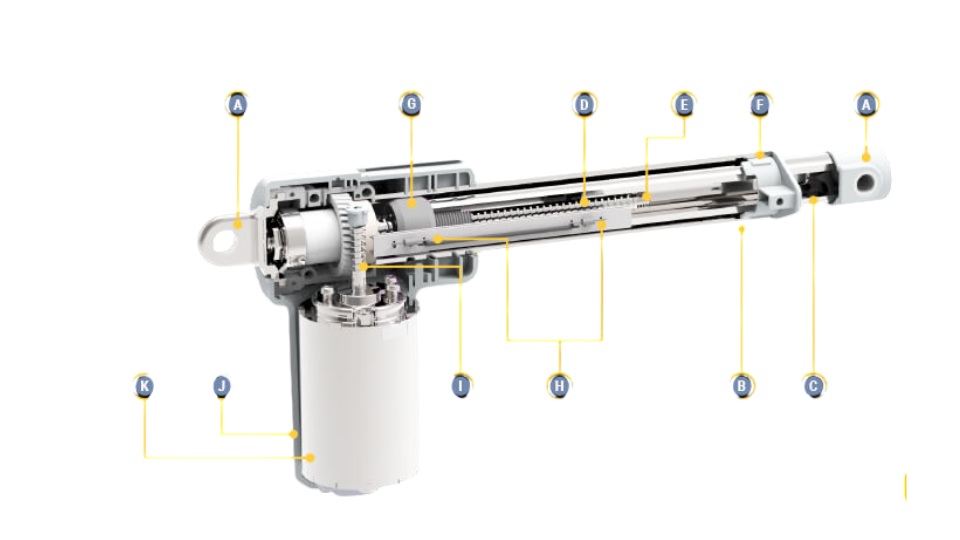
A typical electric linear actuator includes a motor, gearbox, screw mechanism, moving rod, and limit switches. When the control system sends a signal, the motor drives the screw mechanism. The rod then moves forward or backward.

In a hospital bed, this movement connects directly to a mechanical section of the bed.

For example:

Controller → Control System → Linear Actuator → Bed Movement

When the user presses a button to raise the backrest, the control system activates the relevant actuator. The actuator extends or retracts, and the backrest moves to the selected position.

This simple operating principle allows manufacturers to create precise and reliable electric hospital bed adjustment systems.

Why Are Linear Actuators Essential for Hospital Beds?

Hospital beds require controlled movement across several sections. Manual mechanisms can perform some of these adjustments, but electric actuators provide smoother operation and easier control.

A single bed may use several actuators. Each actuator can control a specific movement, while the main control unit coordinates their operation.

For example, a multi-function hospital bed may use separate actuators for:

  • Bed height adjustment

  • Backrest adjustment

  • Leg rest adjustment

  • Trendelenburg position

  • Reverse Trendelenburg position

  • Overall bed tilt

This modular approach allows OEMs to design hospital beds according to different clinical and patient-care requirements.

Key Functions of Linear Actuators in Hospital Beds


1. Bed Height Adjustment

A linear actuator can raise or lower the entire bed frame.

Height adjustment helps caregivers create a suitable working position during patient care. It also allows patients to access the bed more easily when the bed reaches a lower position.

The actuator must provide enough force and stroke length to move the bed smoothly while supporting the required load.

2. Backrest Adjustment

Backrest movement allows the upper section of the bed to move from a flat position to an inclined position.

Patients can use this function while eating, reading, communicating, or resting. Caregivers can also adjust the backrest during routine treatment and patient positioning.

A dedicated actuator provides controlled movement without requiring the caregiver to manually lift the backrest.

3. Leg Section Adjustment

A separate actuator can control the leg or knee section of the bed.

This function gives caregivers more control over patient positioning. It can also work together with the backrest actuator to create a comfortable seated or reclined position.

4. Trendelenburg and Reverse Trendelenburg

Some advanced hospital beds use actuators to tilt the complete bed platform.

Trendelenburg tilts the patient’s head lower than the feet, while reverse Trendelenburg raises the head relative to the feet.

These movements require accurate coordination between the bed’s mechanical structure and actuator control system.

5. Bed Tilt

Linear actuators can also support lateral or overall bed tilting, depending on the bed design.

This function gives healthcare professionals additional positioning options. It also demonstrates why actuator synchronization matters in multi-function hospital beds.

Linear Actuator

Benefits of Linear Actuators for Hospital Beds


Improved Patient Comfort

Electric actuator systems allow users to adjust the bed position without manually moving heavy sections. Patients can achieve more suitable positions for rest and daily activities.

Precise Positioning

Linear actuators provide controlled movement. With the right actuator specification and control system, manufacturers can achieve accurate positioning and repeatable movement.

Reduced Manual Effort

Caregivers do not need to manually lift or adjust heavy bed sections. A simple control input can activate the required actuator.

This can make routine patient care more convenient and reduce unnecessary physical effort.

Better Caregiver Ergonomics

Height-adjustable hospital beds allow caregivers to bring the bed to a suitable working level. This can support better ergonomics during bedside procedures and routine care.

Flexible Bed Design

Multiple actuators allow manufacturers to create different bed configurations. A basic bed can use fewer actuators, while an advanced ICU or critical-care bed can use several actuators for more positioning functions.

Smooth and Controlled Movement

Electric linear actuators can provide controlled extension and retraction. When manufacturers match the actuator’s speed, force, stroke, and duty cycle to the application, the bed can achieve consistent movement.

Easier Integration

Modern actuator systems can integrate with hand controllers, nurse control panels, foot switches, and central bed control units. This gives OEMs flexibility when designing the user interface.

Applications of Linear Actuators in Hospital Beds


Linear actuators support many types of medical and healthcare beds.

Hospital Patient Beds

General hospital beds use actuators for common functions such as height, backrest, and leg adjustment. These functions support everyday patient care.

ICU Beds

Intensive care beds often require more advanced positioning. Multiple actuators can work together to provide several controlled movements.

Electric Nursing Beds

Nursing and long-term care facilities can use actuator-driven beds to improve patient comfort and simplify daily care.

Home Care Beds

Electric home-care beds use compact actuator systems to provide powered positioning for patients who need extended support at home.

Rehabilitation Beds

Rehabilitation facilities can use adjustable beds to support different stages of patient recovery and mobility.

Specialty Medical Beds

Special-purpose beds may require additional movement functions. Manufacturers can select actuator configurations based on the specific application and mechanical design.

What Should Manufacturers Consider When Selecting a Hospital Bed Actuator?


Choosing an actuator requires more than checking its maximum load. The actuator must match the complete mechanical and electrical design of the bed.

Important factors include load capacity, stroke length, speed, retracted length, duty cycle, operating voltage, noise level, mounting configuration, and protection rating.

Manufacturers should also consider how the actuator will work with the control system. Multi-actuator beds need reliable synchronization and appropriate safety logic.

For example, a five-function hospital bed may coordinate several actuators through one central control system. The system should provide predictable movement and prevent conflicting commands.

Emergency functions also require careful planning. Depending on the bed design, manufacturers may include features such as emergency flat or CPR positioning, actuator overload protection, limit control, and handset lockout.

The final actuator specification should always match the bed’s mechanical requirements, intended application, and applicable medical-device requirements.

The Role of the Hospital Bed Actuator Control System

Actuators provide movement, but the hospital bed actuator control system manages how that movement happens.

The control system receives commands from the user interface and sends signals to the correct actuator. In a multi-function bed, it can coordinate several actuators and manage predefined movement sequences.

For example, pressing a single button may trigger a specific combination of actuator movements. The controller can also support functions such as emergency positioning, movement limits, and selected safety controls.

Therefore, the actuator and controller should work as one integrated system. A high-quality actuator alone cannot deliver the desired performance if the control architecture does not match the bed design.

Conclusion

Linear actuators for hospital beds are essential because they transform electrical commands into controlled mechanical movement. They allow modern hospital beds to adjust height, backrest, leg sections, tilt, and other positions with less manual effort.

Their benefits extend beyond movement. Properly selected actuators can support patient comfort, precise positioning, caregiver ergonomics, flexible bed design, and reliable operation.

For medical equipment manufacturers and hospital bed OEMs, actuator selection should consider the complete system rather than one component alone. The actuator, mechanical structure, control unit, user interface, and safety logic must work together.

As electric hospital beds continue to evolve, linear actuator technology and multi-actuator control systems will remain important for creating practical, responsive, and user-friendly patient-care solutions.

Home Care Bed Actuator Systems: Functions, Benefits & Applications

Modern home healthcare requires equipment that supports both patient comfort and easier caregiving. A reliable Home Care Bed Actuator System helps adjust different sections of a motorized bed, allowing patients and caregivers to achieve suitable positions with less manual effort.Home care beds are commonly used for patients who require extended care, recovery support, elderly care, or assistance with daily positioning. Since these beds may need frequent adjustments, manual mechanisms can make positioning difficult. Therefore, linear actuator systems for home care beds provide a practical way to automate bed movement.By combining linear actuators with a suitable control system, home care beds can support functions such as backrest adjustment, leg positioning, and height movement. As a result, motorized bed systems provide greater flexibility during daily patient care.

Why Home Care Bed Actuator Systems Are Important

A Home Care Bed Actuator System controls the mechanical movement of different sections of an electric medical bed. The system converts electrical energy into controlled linear movement, allowing specific sections of the bed to move according to the selected function.

In home care environments, patients may need frequent changes in position while sleeping, resting, eating, reading, or receiving care. Caregivers may also need to adjust the bed during routine activities.

A motorized actuator system can control:

  • Backrest positioning
  • Leg and foot section adjustment
  • Bed height adjustment
  • Patient positioning
  • Multiple bed functions through one control interface

Therefore, actuator-based systems can make bed positioning more convenient and reduce repeated manual adjustments.

How Linear Actuators Work in Home Care Beds

A Linear Actuator for Home Care Beds is an electromechanical device that converts motor rotation into controlled linear movement. This movement is transferred to the corresponding section of the bed.

For example, when a caregiver presses a button to raise the backrest, the control system activates the appropriate actuator. The actuator then extends or retracts, causing the backrest mechanism to move.

The basic process can be understood as:

Control Input → Actuator Control System → Linear Actuator Movement → Bed Position Adjustment

Similarly, separate actuators can control different sections of the bed. This allows manufacturers to develop single-function or multi-function bed systems according to their design requirements.

As a result, Home Care Bed Control System provide a controlled method for operating different mechanical functions of a home care bed.

Electric Linear Actuator

Key Functions of Home Care Bed Actuator Systems

A major advantage of an actuator-based bed is the ability to combine several positioning functions into one coordinated system. The exact configuration depends on the bed design and the number of actuators used.

1. Backrest Adjustment

Backrest adjustment is one of the most common functions of a Motorized Home Care Bed. Patients may require different upper-body positions while sitting, eating, reading, resting, or interacting with caregivers.

A linear actuator provides controlled movement of the backrest section. Furthermore, an electric handset or control panel allows the user or caregiver to adjust the position without manually lifting the bed section.

This supports:

  • Easier patient positioning
  • Convenient daily adjustment
  • Controlled backrest movement
  • Greater positioning flexibility

2. Leg and Foot Section Adjustment

A Home Care Bed Actuator System can also control the leg or foot section. This allows the lower portion of the bed to move according to the selected position.

A dedicated actuator can provide controlled movement while allowing the leg section to operate independently or together with other bed functions.

This function is particularly useful when the bed requires multiple adjustable positions. Moreover, coordinating the leg actuator with the backrest actuator can create a more flexible positioning system.

3. Height Adjustment

Bed height is another important function in modern electric beds. Different situations may require different bed heights.

For example, a caregiver may raise the bed while assisting a patient. A lower position may be preferred during rest or when preparing the bed.

A Hospital Bed Linear Actuator System can provide controlled vertical movement when height adjustment is included in the bed design.

Therefore, height-adjustable actuator systems can give manufacturers greater flexibility when designing home care and medical beds.

4. Multi-Function Bed Positioning

Modern home care beds may include several adjustable functions. As the number of actuators increases, coordinating their operation becomes more important.

A Multi-Function Actuator Control System can coordinate multiple motors through a single control architecture. Depending on the design, the system can manage backrest, leg, height, tilt, and other positioning functions.

This allows manufacturers to develop flexible beds while keeping operation simple for the end user.

Benefits of Home Care Bed Actuator Systems

Beyond movement control, actuator systems provide several practical benefits for patients, caregivers, and medical equipment manufacturers.

1. Reduced Manual Effort

Manual bed adjustment can require physical effort, especially when the bed is frequently repositioned. A motorized system allows the required movement to be controlled electrically.

As a result, caregivers can adjust the bed without manually lifting or repositioning heavy sections.

2. Easier Patient Positioning

Patients may require different positions throughout the day. A Motorized Home Care Bed allows these adjustments to be performed using a handset or control panel.

Therefore, patients and caregivers can make routine positioning changes more conveniently.

3. Smooth and Controlled Movement

Linear actuators provide controlled extension and retraction. When properly integrated with the control system and mechanical structure, they can provide consistent movement of the selected bed section.

This makes actuator technology suitable for applications where controlled positioning is important.

4. Flexible Bed Configuration

Different home care applications may require different numbers of adjustable functions. An actuator-based architecture allows manufacturers to select the appropriate number and configuration of actuators.

Consequently, the same basic technology can be adapted for different bed designs and positioning requirements.

5. Convenient Operation

A handset or control panel can provide dedicated controls for different functions. Instead of manually adjusting individual sections, the user can select the required movement from a centralized interface.

This makes the overall bed operation easier to understand and use.

Control Systems and Handset Operation

The actuator is only one part of a complete Home Care Bed Control System. The control electronics determine how each actuator responds to user input.

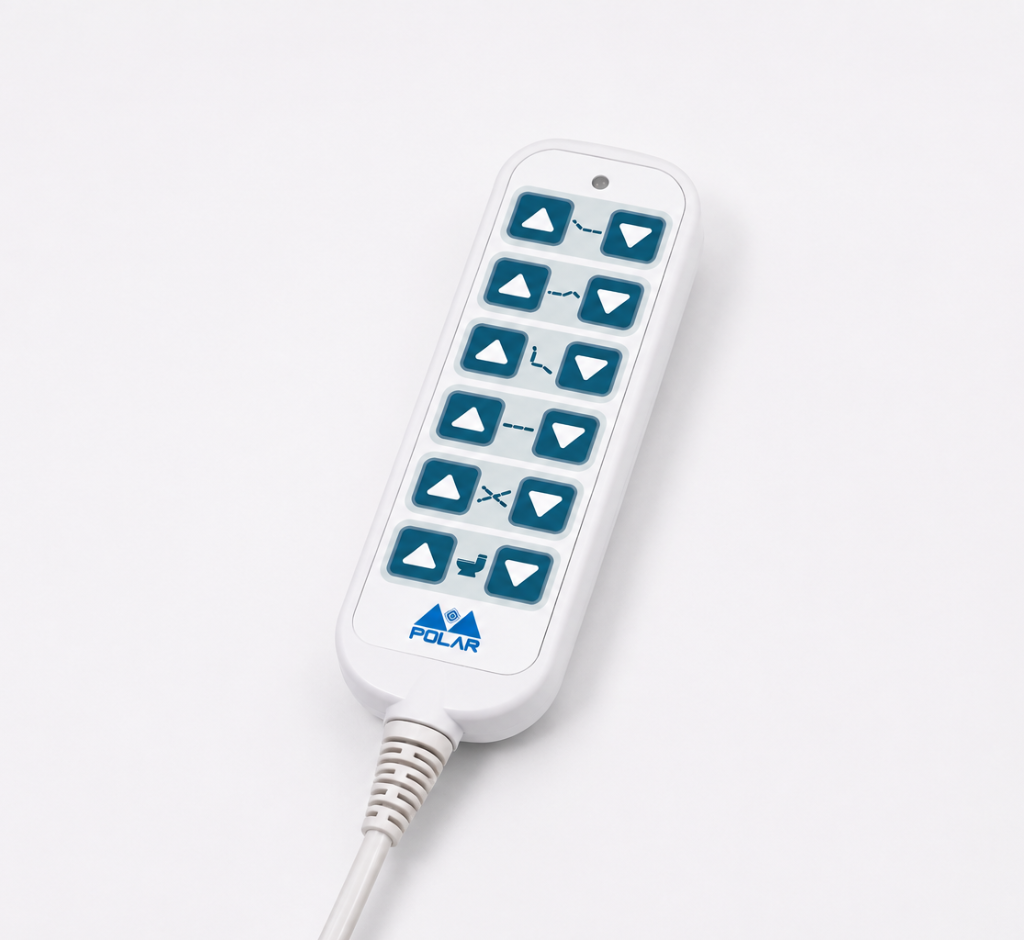
A handset or membrane control panel can provide dedicated buttons for different bed functions. When a button is pressed, the controller sends the appropriate electrical signal to the selected actuator.

The overall architecture can be represented as:

Handset / Control Panel → Control System → Multiple Actuators → Bed Mechanisms

This arrangement allows several functions to be managed through one interface.

Furthermore, integrated control systems can help manufacturers coordinate multiple actuators while maintaining a straightforward operating interface for patients and caregivers.

Applications of Home Care Bed Actuator Systems

Although home healthcare is the primary application, actuator-based bed systems can be used across several patient-care environments.

Home Healthcare: Supports patients receiving extended care at home with adjustable bed positioning.

Elderly Care: Provides motorized positioning functions for beds used in residential and assisted-care environments.

Patient Recovery: Allows adjustable positioning during recovery and rehabilitation.

Long-Term Care: Supports repeated bed adjustments for patients who require ongoing assistance.

Medical Equipment: Linear actuator and control technologies can also be integrated into different types of adjustable medical beds.

Because actuator configurations can be customized, manufacturers can select the number and type of functions according to their specific bed design.

How Polar Automation Supports Home Care Bed Development

Polar Automation develops Linear Actuator Control Systems for medical and patient-care equipment. Its control solutions are designed to coordinate multiple actuators and support different bed functions through integrated control architectures.

For home care bed manufacturers, a suitable actuator control system can provide the foundation for developing multi-function electric beds. Depending on the required configuration, the system can coordinate functions such as backrest, leg, height, and other positioning movements.

Polar Automation also supports modular and embedded control system approaches, allowing manufacturers to select an architecture that suits their equipment design.

This flexibility can benefit OEMs developing home care beds, hospital beds, ICU beds, and other medical positioning systems.

Conclusion

Home healthcare equipment needs to provide convenient positioning while remaining practical for both patients and caregivers. A reliable Home Care Bed Actuator System provides the mechanical and electronic foundation required to automate different bed movements.

From backrest and leg adjustment to height positioning and multi-function operation, linear actuator systems can make everyday bed adjustment easier and more controlled.

Moreover, integrating multiple actuators with a centralized Linear Actuator Control System allows manufacturers to develop flexible electric bed designs while simplifying operation through a handset or control panel.

As home healthcare continues to evolve, Motorized Home Care Beds and actuator-based control systems can play an important role in creating more adaptable, comfortable, and user-friendly patient-care equipment.

Wireless Remote Actuator for Material Handling Automation

Wireless remote actuator systems are increasingly used in material handling automation environments where repeatable motion control and positioning consistency are critical throughout continuous operation.

Modern material handling automation rarely depends on a single movement cycle. Conveyor transfers, indexing stations, lifting mechanisms, pallet handling equipment, and positioning assemblies continuously repeat the same motion sequence throughout daily operation.

As these cycles repeat, positioning consistency becomes increasingly important. Small positioning variations can directly affect transfer timing, synchronization accuracy, equipment coordination, and overall automation stability. Therefore, many industrial motion control systems now depend heavily on repeatable motion control rather than simple actuator movement alone.

Because of this, wireless actuator remote control technology is increasingly integrated into industrial positioning systems requiring synchronized actuator response throughout continuous operation.

Why Repeatable Motion Control Matters

In material handling automation, actuator systems repeatedly execute the same extension, retraction, lifting, and positioning sequence throughout production cycles. Transfer gates open and close continuously, positioning stages coordinate movement repeatedly, and lifting assemblies maintain synchronized motion throughout continuous handling operation.

As a result, repeatable motion control becomes critical for maintaining stable automation performance.

For example, a transfer actuator that positions products between conveyor stages may repeat the same movement hundreds or thousands of times during a production shift. Even small positioning variations can gradually affect transfer alignment, cycle timing, and downstream equipment coordination.

Wireless Remote Actuator

Therefore, industrial positioning systems are designed around predictable actuator response rather than motion generation alone.

The challenge is not simply generating movement. Instead, the challenge is reproducing the same positioning response continuously throughout repeated automation cycles.

Because of this, automation positioning control becomes increasingly important throughout modern industrial automation environments.

The Role of Wireless Remote Actuator Systems

Wireless Remote Actuator

A wireless remote actuator combines DC linear actuation with RF-based wireless communication to support controlled positioning across distributed automation structures.

Unlike traditional wired systems, wireless actuator control systems help reduce external wiring complexity throughout handling environments. Additionally, wireless actuator remote control architecture supports more flexible actuator integration within compact automation structures where cable routing may become restrictive.

At the same time, coordinated actuator response remains critical throughout continuous operation.

Because material handling automation environments often involve multiple synchronized movement stages operating simultaneously, actuator positioning consistency directly influences transfer coordination and system timing stability.

As a result, wireless actuator remote control systems are increasingly used within industrial positioning systems requiring repeatable actuator response throughout continuous automation operation.

Wireless Linear Actuator Integration in Material Handling Automation

Material handling automation includes far more than conveyor movement alone. Modern systems may include transfer gates, indexing stations, pallet handling equipment, lifting assemblies, positioning stages, automated diverters, and compact handling cells operating simultaneously within the same automation structure.

Wireless Remote Actuator

Within these environments, wireless linear actuator systems support:

  • Controlled linear positioning
  • Wireless motion management
  • Repeatable motion control
  • Automation positioning control
  • Synchronized movement coordination
  • Continuous automation operation

In many automation structures, multiple movement systems operate continuously throughout long production cycles. Therefore, wireless actuator control systems help support coordinated motion response across distributed automation environments.

Additionally, RF controlled linear actuator systems support installation flexibility while reducing excessive external control wiring throughout industrial handling structures.

Because of this, wireless linear actuator integration continues expanding throughout material handling automation systems requiring controlled movement coordination and positioning stability.

Why Positioning Consistency Becomes Critical

Positioning consistency becomes increasingly important as automation cycles repeat continuously throughout daily operation.

Initially, motion systems may appear stable. However, over extended operational cycles, even small positioning inconsistencies can gradually affect transfer timing and synchronization accuracy.

For example, if an actuator repeatedly positions products slightly outside the expected transfer alignment, downstream automation equipment may begin experiencing movement timing variations or transfer inconsistencies.

Consequently, repeatable motion control directly influences:

  • Transfer synchronization
  • Positioning accuracy
  • Automation timing stability
  • Coordinated movement response
  • Continuous operational consistency

Industrial positioning systems therefore focus heavily on stable actuator behavior throughout continuous automation operation.

Because of this, wireless remote actuator systems function as positioning interfaces designed around predictable motion response and coordinated handling performance.

How Wireless Actuator Control Systems Support Distributed Automation

Modern automation environments increasingly use distributed handling architectures involving multiple synchronized movement stages operating simultaneously across larger automation structures.

As these systems expand, installation complexity also increases. Consequently, external wiring management may become difficult throughout large automation environments.

Wireless actuator control systems help simplify installation architecture by reducing excessive control wiring while maintaining reliable actuator coordination throughout the system.

At the same time, wireless actuator remote control technology supports more flexible actuator deployment across compact automation structures where conventional cable routing may restrict movement integration.

Because distributed automation systems continuously repeat coordinated movement cycles, wireless motion management becomes increasingly important for maintaining synchronized actuator response.

Therefore, wireless linear actuator systems are increasingly integrated into industrial motion control systems requiring repeatable positioning performance throughout continuous operation.

Motion Synchronization and Continuous Automation Operation

Continuous automation operation depends heavily on synchronized movement coordination between connected automation structures.

If actuator positioning response becomes inconsistent during repeated motion cycles, transfer timing and equipment synchronization may gradually become unstable.

As a result, repeatable motion control directly affects:

  • Handling coordination
  • Equipment synchronization
  • Automation timing consistency
  • Positioning stability
  • Continuous movement response

Because of this, wireless remote actuator systems combine linear motion control with RF-based wireless management to support stable positioning coordination throughout continuous automation operation.

Wireless actuator remote control technology therefore supports industrial automation environments requiring predictable actuator behavior throughout repeated handling cycles.

Linear Motion Control in Industrial Automation

Linear motion control plays a major role throughout modern automation systems. Transfer systems, lifting assemblies, diverters, positioning stages, and indexing equipment all depend on controlled actuator response during continuous operation.

However, motion alone is not sufficient. Instead, industrial automation systems require repeatable positioning behavior capable of maintaining synchronization stability throughout extended operational cycles.

Therefore, linear motion control systems increasingly focus on:

  • Controlled actuator positioning
  • Repeatable automation response
  • Stable synchronization performance
  • Coordinated handling operation
  • Continuous positioning consistency

Because of this, wireless remote actuator systems continue supporting modern material handling automation environments where repeatable positioning response remains critical for operational stability.

Conclusion

Material handling automation depends heavily on repeatable motion cycles throughout continuous operation. Although actuator movement remains important, positioning consistency ultimately determines transfer coordination, synchronization stability, and overall automation reliability.

Wireless remote actuator systems combine DC linear actuation with RF-based wireless control to support controlled positioning across distributed automation environments while reducing external control wiring complexity.

As industrial automation systems continue evolving, repeatable motion control and synchronized positioning response will remain essential throughout modern material handling automation environments.

Integrated Motion Control Systems for Reliable Hospital Bed Operation

Modern healthcare facilities require advanced equipment that delivers reliability, smooth movement, and patient safety. Among the most important technologies used in modern patient care systems is the Hospital Bed Controller. Today, every advanced electric hospital bed system depends on a reliable Hospital Bed Controller for synchronized movement and stable operation.

A modern Hospital Bed Controller helps coordinate actuators, control boxes, patient handsets, and embedded wiring systems. As a result, hospitals can achieve better patient positioning, smoother movement, and improved caregiver efficiency.

At Polar Automation, integrated motion control solutions are designed to support reliable hospital bed operation through intelligent automation and synchronized movement systems. Furthermore, these technologies help improve long-term operational stability across ICU beds, rehabilitation beds, and advanced patient care equipment.

What Is a Hospital Bed Controller?

A Hospital Bed Controller is the central electronic unit responsible for managing and coordinating the movement functions of a hospital bed. In simple terms, the Hospital Bed Controller acts as the communication center between actuators, motors, handsets, and power systems.

Whenever a caregiver adjusts the bed position, the Hospital Bed Controller sends commands to the connected actuators. Consequently, the bed performs smooth and synchronized movement without instability.

Modern hospital beds include several movement functions such as:

  • Backrest adjustment
  • Leg-rest positioning
  • Height adjustment
  • Tilt positioning
  • Patient repositioning

Therefore, a reliable Hospital Bed Controller becomes essential for maintaining safe and stable movement.

Without a proper Hospital Bed Controller, hospital beds may experience uneven positioning, unstable motion, or interrupted actuator communication. For this reason, integrated motion systems are increasingly important in modern healthcare environments.

Hospital Bed Controller

Importance of Hospital Bed Motion Control Systems

Today, healthcare providers depend heavily on advanced hospital bed control system technology for patient comfort and operational efficiency.

Previously, many hospital beds relied on manual adjustment systems. However, modern automation technology has completely transformed hospital bed operation. As a result, hospitals can now improve patient handling while reducing caregiver workload.

A high-quality Hospital Bed Controller helps improve:

  • Movement synchronization
  • Patient safety
  • Positioning precision
  • Caregiver convenience
  • Operational reliability

Additionally, integrated systems help reduce maintenance complexity and improve long-term durability.

Because hospital beds are used continuously in healthcare environments, reliable motion control becomes extremely important.

Role of Electric Linear Actuators in Hospital Beds

Hospital Bed Controller

An electric linear actuator is responsible for converting electrical energy into linear movement. In hospital bed systems, actuators control functions such as lifting, reclining, and tilting.

For example, one actuator may control the backrest while another actuator controls leg positioning. Similarly, additional actuators may manage height adjustment and Trendelenburg movement.

Since multiple actuators operate together, proper synchronization is necessary. Otherwise, the bed may move unevenly or become unstable.

A reliable hospital bed linear actuator controller helps coordinate actuator communication efficiently. Consequently, hospitals can achieve smooth and synchronized movement across all bed functions.

Furthermore, integrated actuator systems help reduce mechanical stress. Therefore, they support long-term reliability in demanding healthcare environments.

Why Medical Bed Automation Is Important

Modern healthcare facilities are increasingly adopting advanced medical bed automation systems. As healthcare technology evolves, hospitals require intelligent systems that improve patient care and operational efficiency.

Automated systems allow caregivers to adjust bed positioning quickly and accurately. In addition, patients experience smoother and more comfortable movement.

A Hospital Bed Controller plays a major role in supporting this automation process. Moreover, it helps ensure reliable communication between all connected components.

Today, automated systems are widely used in:

  • ICU beds
  • Fowler beds
  • Rehabilitation beds
  • Home care beds
  • Advanced patient care systems

Because of growing healthcare demands, automation technology continues to expand rapidly.

Common Challenges in Hospital Bed Systems

Although advanced hospital beds provide many advantages, several operational challenges can still occur. Therefore, integrated control systems are essential for reliable operation.

Movement Synchronization Issues

If actuators fail to communicate properly, the bed may move unevenly. As a result, patient comfort and safety may be affected.

Wiring Complexity

Modern hospital beds contain multiple electronic components. Consequently, wiring architecture can become complicated.

However, integrated systems help simplify internal wiring and improve signal organization.

Controller Instability

An unstable Hospital Bed Controller may cause delayed movement response or inconsistent positioning.

Therefore, hospitals require advanced control systems designed for continuous operation.

Difficult Diagnostics

Without centralized architecture, troubleshooting becomes more difficult and time-consuming.

Integrated systems help simplify diagnostics and maintenance procedures.

Long-Term Operational Stress

Hospital beds operate continuously in healthcare environments. Therefore, components must maintain reliable performance over long periods.

A high-quality Hospital Bed Controller helps improve long-term system durability.

Benefits of Integrated Motion Control Systems

Integrated motion systems provide several operational benefits for healthcare equipment manufacturers and hospitals.

Reliable Synchronized Movement

A modern Hospital Bed Controller helps maintain smooth and coordinated actuator movement. Consequently, patients experience stable and comfortable positioning.

Reliable synchronization also improves caregiver efficiency during patient handling.

Simplified Wiring Systems

Integrated architecture helps reduce wiring complexity and improve communication management.

As a result, maintenance becomes easier and system reliability improves.

Improved Patient Safety

Smooth movement coordination helps prevent sudden jerks and unstable positioning.

Therefore, integrated systems are highly beneficial for ICU and critical care environments.

Better Maintenance and Diagnostics

A centralized linear actuator controller helps technicians identify faults quickly and efficiently.

Consequently, hospitals can reduce downtime and improve servicing speed.

Long-Term Reliability

Integrated systems are designed for demanding healthcare applications. Therefore, they support stable performance over extended operating periods.

Because of this, hospitals can improve operational consistency and reduce maintenance costs.

ICU Bed Actuator System Applications

An advanced ICU bed actuator system requires accurate and reliable motion coordination. Since ICU patients require continuous care, stable positioning becomes extremely important.

A reliable Hospital Bed Controller helps ICU beds perform multiple movement functions safely and efficiently.

Additionally, integrated systems support:

  • Emergency positioning
  • Patient monitoring access
  • Smooth movement transitions
  • Improved caregiver handling

As healthcare automation continues to evolve, ICU systems are becoming more intelligent and efficient.

Importance of an Electric Hospital Bed System

A modern electric hospital bed system improves both patient comfort and caregiver productivity.

Furthermore, electric systems reduce manual effort and improve positioning accuracy.

Today, healthcare facilities depend on advanced electric hospital bed systems because they help improve:

  • Patient mobility
  • Caregiver efficiency
  • Movement precision
  • Operational safety
  • Equipment durability

A reliable Hospital Bed Controller is one of the most important components within these systems.

Future Trends in Hospital Bed Automation

The future of healthcare equipment is strongly connected to intelligent automation and smart motion technology.

In the coming years, hospitals may increasingly adopt:

  • Wireless control systems
  • IoT-enabled monitoring
  • Smart positioning technology
  • Sensor-based automation
  • Energy-efficient actuator systems
  • Advanced synchronization technology

As a result, hospital bed systems will become smarter and more efficient.

Integrated motion systems will continue to play a major role in supporting advanced patient care solutions.

Why Choose Polar Automation

Polar Automation provides reliable automation and motion control solutions for modern healthcare applications.

The company focuses on advanced Hospital Bed Controller systems, synchronized actuator integration, and intelligent movement architecture.

Furthermore, Polar Automation supports healthcare equipment manufacturers with:

  • Reliable actuator systems
  • Intelligent control integration
  • Simplified wiring architecture
  • Long-term operational stability
  • Advanced hospital bed automation solutions

These systems are suitable for ICU beds, rehabilitation beds, Fowler beds, and advanced patient care equipment.

Conclusion

A reliable Hospital Bed Controller is essential for safe, smooth, and synchronized hospital bed operation. As healthcare environments continue to evolve, integrated motion control systems are becoming increasingly important for patient comfort and operational efficiency.

By combining electric actuators, centralized control systems, intelligent wiring architecture, and synchronized communication, hospitals can improve movement precision and long-term reliability.

Furthermore, integrated automation systems help simplify maintenance, improve patient handling, and support advanced healthcare operations.

As a result, modern Hospital Bed Controller technology continues to play a major role in the future of hospital bed automation and patient care systems.

7 Function Hospital Bed Actuator System for Advanced Medical Beds

A 7 Function Hospital Bed Actuator system is an advanced motion control solution designed for modern hospital beds, ICU beds, rehabilitation beds, and healthcare furniture applications. These systems combine synchronized electric linear actuators, intelligent control electronics, and multi-function patient remotes to provide smooth and reliable patient positioning.

Modern hospitals require advanced medical equipment that supports patient comfort, smooth movement control, and efficient healthcare operation. Therefore, automated hospital bed systems have become an essential part of ICU beds, rehabilitation beds, Fowler beds, and home-care medical furniture.

Moreover, these systems support smooth positioning adjustment while maintaining stable operation during continuous usage. Unlike manual bed systems, automated actuator technology improves patient handling and reduces physical effort for caregivers. In addition, synchronized actuator coordination helps maintain smooth movement transfer between different bed sections.

As healthcare technology continues evolving, hospitals increasingly prefer intelligent motion control systems that provide reliable performance, low-noise operation, and advanced positioning flexibility. Consequently, actuator systems now play a major role in modern healthcare infrastructure.


What is a 7 Function Hospital Bed Actuator?

7 Function Hospital Bed Actuator

A 7 Function Hospital Bed Actuator is an electromechanical motion control system designed to automate multiple hospital bed positioning functions. These systems use synchronized actuators, control units, and patient remotes to achieve smooth and coordinated bed movement.

Typically, the system supports:

  • Backrest adjustment
  • Leg positioning
  • Bed height movement
  • Trendelenburg positioning
  • Reverse Trendelenburg movement
  • Chair positioning
  • Rehabilitation positioning

As a result, healthcare professionals can position patients more comfortably and efficiently according to medical requirements.

Furthermore, intelligent actuator synchronization helps maintain balanced movement during simultaneous adjustment operations. Consequently, hospitals achieve improved patient comfort and safer movement control. In addition, automated positioning systems help reduce manual handling efforts for healthcare staff.


Importance of 7 Function Hospital Bed Actuator in Healthcare

Modern healthcare environments require reliable patient positioning systems for critical care and rehabilitation applications. Therefore, advanced actuator systems are widely integrated into:

  • ICU beds
  • Critical care beds
  • Rehabilitation beds
  • Fowler beds
  • Home-care beds
  • Long-term patient care systems

In addition, automated positioning functions improve patient mobility and reduce caregiver workload during daily operation.

Because patient posture directly impacts comfort and healthcare support, hospitals increasingly rely on synchronized actuator technologies for advanced medical beds. Moreover, intelligent movement systems help improve operational efficiency while supporting smooth and controlled patient handling.

Similarly, automated bed systems contribute to safer healthcare procedures by minimizing unnecessary physical strain during patient repositioning.


Motion Coordination in 7 Function Hospital Bed Actuator Systems

One of the most important features of a 7 Function Hospital Bed Actuator system is synchronized motion coordination. Multiple actuators operate together through centralized control architecture to provide stable and accurate movement.

The actuator system integrates:

  • Medical linear actuators
  • Intelligent control electronics
  • Multi-function patient remotes
  • Synchronized motion control systems

Consequently, different bed sections can move simultaneously without affecting positioning stability.

For example, chair positioning and rehabilitation movement require coordinated adjustment between the backrest, leg section, and bed height system. Therefore, synchronized actuator operation helps maintain smooth transition between bed positions.

Additionally, intelligent control electronics help reduce mechanical stress during repeated movement cycles while maintaining safe operation. Furthermore, stable motion synchronization improves overall patient comfort during continuous positioning adjustments.


Key Features of 7 Function Hospital Bed Actuator Systems

Smooth Positioning Adjustment

The actuator system provides stable and controlled movement for multiple bed functions. As a result, patients experience smoother positioning during treatment and recovery.


Intelligent Motion Synchronization

Advanced synchronization technology helps maintain balanced actuator movement during simultaneous adjustment operations. Moreover, coordinated motion improves patient comfort and positioning accuracy.


Low Noise Operation

Modern healthcare environments require silent equipment operation. Therefore, actuator systems are designed for low-noise movement suitable for ICU and patient care applications.

In addition, reduced operational noise helps create a more comfortable healthcare environment for patients and caregivers.


Reliable Continuous Performance

Hospital bed actuator systems are developed for continuous-duty medical applications. Consequently, they maintain stable operation during repeated usage cycles.

Furthermore, reliable actuator performance helps healthcare facilities maintain uninterrupted patient care support.


High Load Handling Capability

Advanced actuator systems support heavy-duty hospital bed applications while maintaining smooth movement performance. As a result, hospitals can use these systems for various healthcare furniture configurations.


Compact Medical Integration

The actuator system integrates efficiently within modern medical bed structures. In addition, compact electronic design improves overall healthcare furniture functionality.

Moreover, integrated actuator systems help optimize medical bed design without affecting operational efficiency.


Role of Linear Actuator Controller in Hospital Beds

A Linear Actuator Controller manages communication between actuators, patient remotes, and electronic control systems. Therefore, it plays an important role in synchronized movement coordination and operational safety.

The controller system supports:

  • Motion synchronization
  • Position management
  • Safety protection functions
  • Overload prevention
  • Limit switch monitoring

As a result, hospitals achieve smooth and reliable bed operation during continuous patient care.

Furthermore, intelligent controllers improve actuator efficiency while reducing operational stress on mechanical components. Consequently, the overall performance stability of the hospital bed system improves significantly.


Benefits of Linear Actuator 24V Systems

7 Function Hospital Bed Actuator

Most medical bed systems use Linear Actuator 24V technology because it provides safe and efficient operation.

Major advantages include:

  • Smooth actuator movement
  • Low operational noise
  • Stable power efficiency
  • Reliable continuous-duty performance
  • Safe low-voltage operation

In addition, 24V actuator systems are highly suitable for healthcare environments where controlled and silent movement is essential.

Because of their stable operational characteristics, these systems are widely preferred in advanced hospital beds and medical furniture applications. Furthermore, low-voltage actuator systems support safer healthcare operation standards.


Importance of Patient Remote Systems

7 Function Hospital Bed Actuator

Patient remotes are essential components of advanced hospital bed systems. These remotes allow patients and caregivers to control multiple bed functions conveniently and safely.

The 7 function remote supports:

  • Independent bed movement control
  • Ergonomic operation
  • Medical-grade button interface
  • Durable construction
  • Reliable continuous operation

Moreover, easy-to-use button layouts improve operational convenience for both patients and healthcare staff.

As a result, patient remotes contribute significantly to overall patient comfort and healthcare efficiency. Additionally, intuitive controls help improve usability during continuous medical care operation.


Advantages of 7 Function Hospital Bed Actuator Technology

Improved Patient Comfort

Advanced positioning functions support rehabilitation, treatment, and long-term patient care applications.

Better Caregiver Efficiency

Automated movement systems reduce manual effort during patient handling procedures. Consequently, healthcare staff can manage patient positioning more efficiently.

Stable Motion Coordination

Synchronized actuators maintain balanced movement during multiple positioning adjustments. In addition, stable movement improves operational reliability.

Quiet Healthcare Operation

Low-noise actuator systems improve comfort in hospitals and ICU environments. Therefore, patients experience a better recovery environment.

Reliable Long-Term Performance

Medical actuator systems are designed for continuous healthcare applications. Moreover, durable actuator construction supports long operational service life.

Therefore, healthcare facilities increasingly adopt intelligent actuator systems for modern patient care infrastructure.


Applications of 7 Function Hospital Bed Actuator Systems

A Hospital bed linear actuator system is widely used across various healthcare applications, including:

  • ICU beds
  • Critical care beds
  • Fowler beds
  • Rehabilitation beds
  • Home-care beds
  • Advanced medical furniture systems

Moreover, synchronized motion systems improve patient mobility and healthcare operational efficiency. As a result, hospitals achieve better patient care support through intelligent positioning systems.


Polar Automation – Advanced Hospital Bed Actuator Solutions

Polar Automation specializes in advanced medical motion control systems for hospital beds and healthcare furniture applications. The company develops synchronized actuator technologies designed for smooth and reliable patient positioning.

Their solutions include:

  • 7 Function Hospital Bed Actuator systems
  • Linear Actuator Controller integration
  • Linear Actuator 24V systems
  • Multi-function patient remotes
  • Intelligent medical control electronics
  • Advanced synchronized actuator systems

Moreover, their products are designed for ICU beds, rehabilitation systems, Fowler beds, and modern healthcare furniture applications. Consequently, healthcare manufacturers can integrate reliable motion control technologies into advanced medical bed systems.


Future of 7 Function Hospital Bed Actuator Technology

Healthcare engineering is continuously evolving toward intelligent and automated patient care systems. Therefore, demand for advanced actuator technologies continues increasing across healthcare industries.

Modern healthcare environments require:

  • Intelligent motion control
  • Automated patient positioning
  • Reliable synchronized movement
  • Compact medical electronics
  • Advanced rehabilitation support systems

Consequently, actuator systems will continue playing a major role in future healthcare infrastructure and medical furniture development. Furthermore, increasing healthcare automation will drive demand for advanced synchronized movement technologies.


Conclusion

A 7 Function Hospital Bed Actuator system provides advanced movement control for modern healthcare applications. By integrating synchronized actuators, intelligent control electronics, and ergonomic patient remotes, these systems support smooth and reliable hospital bed positioning.

From advanced Linear Actuator Controller technology to efficient Linear Actuator 24V systems, automated medical bed solutions improve patient comfort, caregiver convenience, and operational efficiency.

With advanced engineering and healthcare-focused innovation, Polar Automation continues delivering reliable actuator systems for modern hospital beds and medical furniture applications.

Dental Chair Linear Actuator: Working, Components & Benefits

Introduction

The dental industry is rapidly evolving toward automation, and therefore, precision-based equipment is becoming more important than ever. In this transformation, the dental chair linear actuator plays a crucial role. It ensures smooth, controlled, and accurate movement of dental chairs. As a result, dentists can perform procedures more efficiently, while patients experience better comfort.

Moreover, modern dental clinics require equipment that is silent, reliable, and easy to control. Because of this, electric actuator systems are now widely replacing traditional mechanisms. At Polar Automation, advanced actuator solutions are designed specifically to meet these demanding healthcare requirements.

In this blog, we will therefore understand the working, components, applications, and benefits of dental chair linear actuators in detail.


What is a Dental Chair Linear Actuator?

Dental Chair Linear Actuator

A dental chair linear actuator is an electromechanical device that converts electrical energy into linear motion. In simple terms, it helps move different parts of a dental chair in a controlled manner.

For instance, it adjusts:

  • Seat height
  • Backrest angle
  • Leg support
  • Chair tilt and positioning

In contrast to hydraulic systems, an electric linear actuator system offers cleaner operation, higher accuracy, and lower maintenance. Therefore, it is widely preferred in modern dental environments where hygiene and precision are critical.


Working of Dental Chair Linear Actuator

Dental Chair Linear Actuator

The working of a dental chair linear actuator developed by Polar Automation is based on controlled conversion of electrical energy into mechanical movement. Consequently, the dental chair moves smoothly and accurately during operation.

Step 1: Power Input

First, the actuator receives regulated DC power, typically 12V or 24V, from the control system. This ensures safe and stable performance in medical environments.

Step 2: Motor Activation

Next, the internal DC motor starts rotating once power is supplied. Importantly, this motor is designed for low noise and long life, which is essential for dental applications.

Step 3: Motion Transmission System

After that, the rotational motion is transferred through a precision mechanical system. As a result, speed is reduced while torque is increased, ensuring controlled movement.

Step 4: Linear Motion Generation

Subsequently, the system converts rotary motion into precise linear movement. Therefore, the dental chair adjusts smoothly to the required position.

Step 5: Controlled Chair Movement

Finally, based on control signals, the actuator extends or retracts. In this way, it adjusts height, tilt, or recline positions with stability and accuracy.

Final Outcome

Overall, this entire process ensures silent operation, high precision, stable load handling, and long service life, which are essential for dental procedures.


Key Components of Dental Chair Linear Actuator

A high-quality electric linear actuator system consists of several important components. Each of them plays a vital role in performance.

1. Electric Motor

To begin with, the motor generates rotational force. Moreover, it is designed for energy efficiency and silent operation.

2. Mechanical Transmission System

In addition, this system transfers motion and increases torque for smooth lifting performance.

3. Outer Housing

Furthermore, the housing protects internal parts from dust, moisture, and mechanical damage.

4. Control Interface

Meanwhile, the control system manages direction, speed, and positioning based on user input.

5. Sensors (Feedback System)

Similarly, sensors provide feedback to ensure accurate movement and positioning.

6. Mounting Brackets

Finally, brackets ensure stable installation and secure fitting within the dental chair structure.


Types of Dental Chair Linear Actuator Used

There are several types of actuators used depending on application needs. Therefore, selection depends on design and load requirements.

1. Inline Linear Actuators

These are compact and efficient. As a result, they are widely used in modern dental chairs.

2. Parallel Linear Actuators

In contrast, these are used where space is limited and compact design is required.

3. High Load Capacity Linear Actuators

Moreover, these are designed for heavy-duty usage. Therefore, they are ideal for high-usage dental clinics.

4. Custom Linear Actuators

Additionally, custom actuators are designed based on OEM requirements such as stroke, load, and speed.


Benefits of Dental Chair Linear Actuator

The use of motorized linear actuator India solutions has significantly improved dental equipment performance. Therefore, clinics are rapidly adopting this technology.

1. Smooth and Silent Operation

First and foremost, the actuator ensures noise-free movement, which improves patient comfort.

2. High Precision Control

Moreover, it allows dentists to position chairs accurately for different treatments.

3. High Load Capacity

In addition, a high load capacity linear actuator ensures stable performance even under continuous use.

4. Improved Patient Comfort

As a result, smooth motion reduces stress and enhances patient experience.

5. Better Ergonomics

Similarly, dentists can work in better posture, which reduces physical strain.

6. Low Maintenance

Furthermore, electric systems require less maintenance compared to hydraulic systems.

7. Energy Efficiency

At the same time, these systems consume less power while maintaining performance.

8. Enhanced Safety

Finally, built-in safety systems ensure controlled and secure operation.


Applications in Dental Chairs

Dental Chair Linear Actuator

A dental chair linear actuator is widely used across multiple functions. For example:

  • Chair height adjustment
  • Backrest reclining
  • Leg support movement
  • Headrest positioning
  • Full chair tilt control

Therefore, it plays a vital role in ensuring smooth dental procedures and patient comfort.


Why OEMs Prefer Linear Actuators

Modern manufacturers prefer OEM linear actuator for dental chairs because it offers multiple advantages. For instance:

  • Easy integration into chair systems
  • Compact and lightweight design
  • Reliable continuous performance
  • Compatibility with electronic controls
  • Long operational life

Moreover, leading linear actuator manufacturers in India are focusing on advanced designs that meet global standards.


Polar Automation Solutions for Dental Chair Linear Actuator

Polar Automation specializes in advanced motion control systems. In fact, their electric linear actuator systems are engineered for healthcare precision.

Specifically, they offer:

  • Smooth and accurate motion control
  • High durability and reliability
  • Custom engineering for OEM needs
  • Stable performance in medical environments
  • Easy system integration

Therefore, Polar Automation supports manufacturers in building next-generation dental equipment.


Future of Dental Chair Linear Actuator

The future of dental automation is becoming smarter. For example, new systems are evolving with:

  • IoT-based control systems
  • Memory positioning features
  • Ultra-quiet actuator designs
  • Energy-efficient motors
  • Smart digital integration

As a result, custom linear actuators will play a major role in next-generation dental technology.


Conclusion

In conclusion, the dental chair linear actuator is a vital component in modern dental systems. It ensures smooth movement, precise control, and enhanced comfort for both dentists and patients.

Moreover, with growing demand for electric linear actuator systems, high load capacity actuators, and OEM solutions, Polar Automation continues to deliver advanced motion technology in India.

Finally, as dental clinics move toward automation, linear actuators will remain essential for improving efficiency, safety, and patient experience.