
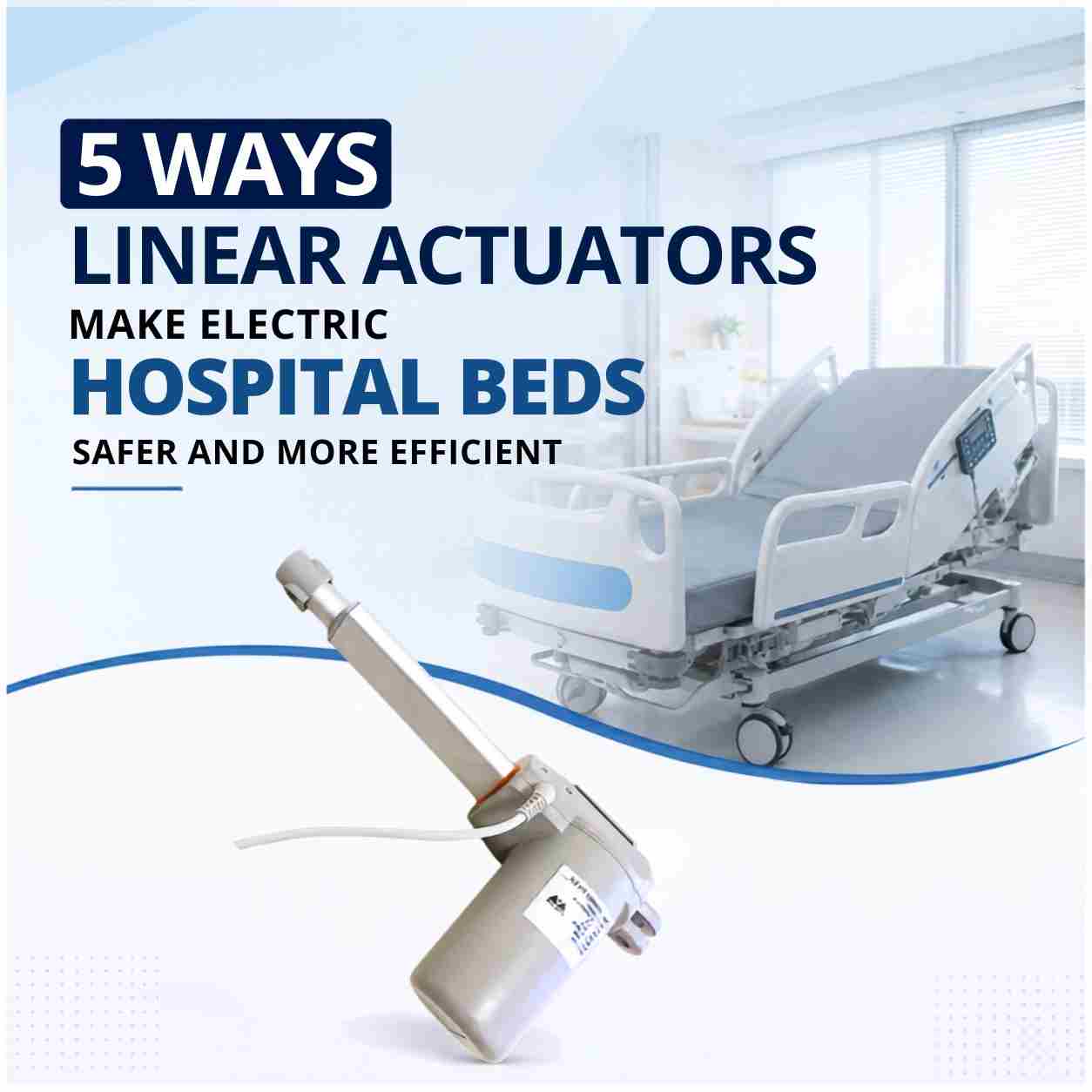
What happens when a hospital bed needs to move a patient quickly, safely, and precisely? Manual mechanisms can slow down caregivers and make positioning harder. That is why modern electric hospital beds rely on Linear Actuators for controlled movement.
From raising the bed height to adjusting the backrest, leg section, and tilt, Linear Actuators help turn simple electrical commands into smooth mechanical movement. When combined with an intelligent control system, they can also support safer operation and multiple bed functions.
But what makes Linear Actuators so important for modern hospital beds? Here are five key ways they improve safety, efficiency, and overall bed performance.
What Are Linear Actuators?
Linear Actuators are electromechanical devices that convert rotary motion from an electric motor into controlled linear movement. In simple terms, they push or pull a connected part to move it into the required position.
In hospital beds, Linear Actuators can control different sections of the bed. For example, one actuator can raise the backrest while another adjusts the leg section. A separate actuator can control the overall bed height.
This allows patients and caregivers to change the bed position with a simple control command.
1. Linear Actuators Provide Precise Bed Positioning
Patient positioning plays an important role in hospital care. A bed may need to move into different positions during examination, treatment, recovery, or daily care.
Linear Actuators provide controlled movement for these adjustments. The motor moves the actuator shaft, which then changes the position of the connected bed section.
This precise movement can help achieve positions such as:
- Raised or lowered bed height
- Adjustable backrest
- Raised or lowered leg section
- Tilted bed position
- Trendelenburg position
- Reverse Trendelenburg position
A well-designed actuator system also allows the movement to stop at the required position. This gives patients and caregivers better control over the bed.
For OEMs, precise positioning also makes it easier to develop beds with multiple functions without adding complex mechanical systems.
2. Linear Actuators Reduce Manual Effort
Moving a hospital bed manually can require significant physical effort. Caregivers may need to adjust the patient’s position several times during a shift.
Electric Linear Actuators reduce this workload by handling the movement through motorized operation.
With a suitable control system, the caregiver can select the required function using a hand control, nurse control panel, or other interface. The actuator then moves the bed section smoothly.
This can save time during routine activities such as:
- Patient repositioning
- Bed height adjustment
- Clinical examination
- Patient transfer
- Nursing procedures
- Comfort adjustments
Reducing manual movement can also help caregivers focus more on patient care instead of mechanical bed adjustments.
3. Linear Actuators Support Safer Patient Movement
Safety becomes critical when a hospital bed moves while a patient is lying on it. Sudden or uncontrolled movement can create unnecessary risks.
Modern Linear Actuators in hospital bed systems can work with electronic control units that manage actuator movement and system limits.
For example, a control system can coordinate several actuators instead of operating each motor independently. This helps the bed perform complex movements in a controlled sequence.
Safety-focused actuator control can also support functions such as:
- Emergency flat or CPR positioning
- Controlled stopping
- Movement limits
- Coordinated actuator operation
- Protection against conflicting commands
The actuator itself provides the mechanical movement. The control system determines how and when that movement occurs.
This combination is important for modern electric hospital bed designs.
4. Multiple Linear Actuators Enable More Bed Functions
One of the biggest advantages of using Linear Actuators is scalability.
A basic electric bed may only require a small number of movement functions. However, advanced hospital beds can require several independent adjustments.
For example, a multi-function bed can use separate actuator channels for:
Height + Backrest + Leg Section + Tilt + Trendelenburg
Each function can operate through its own actuator while the control system coordinates the complete system.
This approach gives medical equipment manufacturers more flexibility when developing different bed models.
Instead of redesigning the complete mechanical system for every model, manufacturers can create different configurations around a modular actuator and control architecture.
That can simplify product development and help OEMs build beds with different levels of functionality.
5. Linear Actuators Improve Operational Efficiency
Efficiency is not only about speed. It also involves reliability, simplified installation, reduced wiring, and easier system integration.
A properly designed actuator system can help OEMs create cleaner and more organized hospital bed designs.
Modern control architectures can coordinate several actuators through a central control unit. This reduces the need for complicated individual control arrangements.
For manufacturers, this can provide benefits such as:
- Simplified system integration
- Cleaner wiring architecture
- Easier assembly
- Coordinated movement
- Flexible bed configurations
- Better user control
For hospitals, efficient bed operation can support smoother workflows for caregivers.
The result is a system that combines mechanical movement with intelligent electronic control.
Why Actuator Control Matters as Much as the Actuator
Choosing the right Linear Actuator is only one part of designing an electric hospital bed.
The actuator needs a suitable control system to perform reliably. The controller manages inputs from the hand control, nurse panel, or other interfaces and sends the appropriate commands to the actuators.
A multi-function hospital bed may need to coordinate several motors at the same time. The control system therefore becomes an important part of the overall architecture.
For example, an advanced actuator control system can coordinate multiple functions while supporting safety responses such as emergency positioning.
This is especially important for beds that use four or more actuators.
How to Choose Linear Actuators for Hospital Beds
OEMs should consider several factors before selecting Linear Actuators for a medical bed.
Load Capacity
The actuator must support the required load without compromising movement or reliability. Consider the patient weight, mattress, bed structure, and dynamic loads.
Stroke Length
Stroke determines how far the actuator can extend or retract. The correct stroke depends on the required range of bed movement.
Speed
Actuator speed affects how quickly the bed reaches the desired position. However, higher speed should not come at the expense of controlled movement.
Duty Cycle
Hospital beds may perform repeated adjustments throughout the day. The actuator should match the expected operating cycle.
Noise Level
Low operating noise can improve the patient experience, especially in hospitals and care environments where quiet operation matters.
Safety and Integration
The actuator should work effectively with the selected control box and user interface. Mechanical limits, electrical protection, and coordinated control all contribute to system safety.
The Future of Linear Actuators in Hospital Beds
Hospital bed technology continues to move toward smarter and more integrated designs. Linear Actuators will remain important because they provide the physical movement required by these systems.
Future designs may place greater emphasis on intelligent control, easier integration, wireless communication, improved diagnostics, and more responsive safety functions.
For OEMs, this means actuator selection should not happen in isolation. The actuator, control box, handset, sensors, and software logic should work together as one system.
This integrated approach can help manufacturers create beds that are easier to operate, assemble, maintain, and customize.
Conclusion
Linear Actuators have become an important part of modern electric hospital beds. They provide controlled movement, reduce manual effort, support safer patient positioning, enable multiple bed functions, and improve overall operating efficiency.
However, the actuator is only one part of the solution. A reliable control system must coordinate the actuators and manage bed functions safely.
For medical equipment OEMs, the right combination of Linear Actuators and intelligent actuator control can create a more flexible and efficient hospital bed platform.
If you are developing an electric hospital bed and need a suitable actuator and control solution, explore Polar Automation’s Hospital Bed Linear Actuator solutions for medical applications.
