
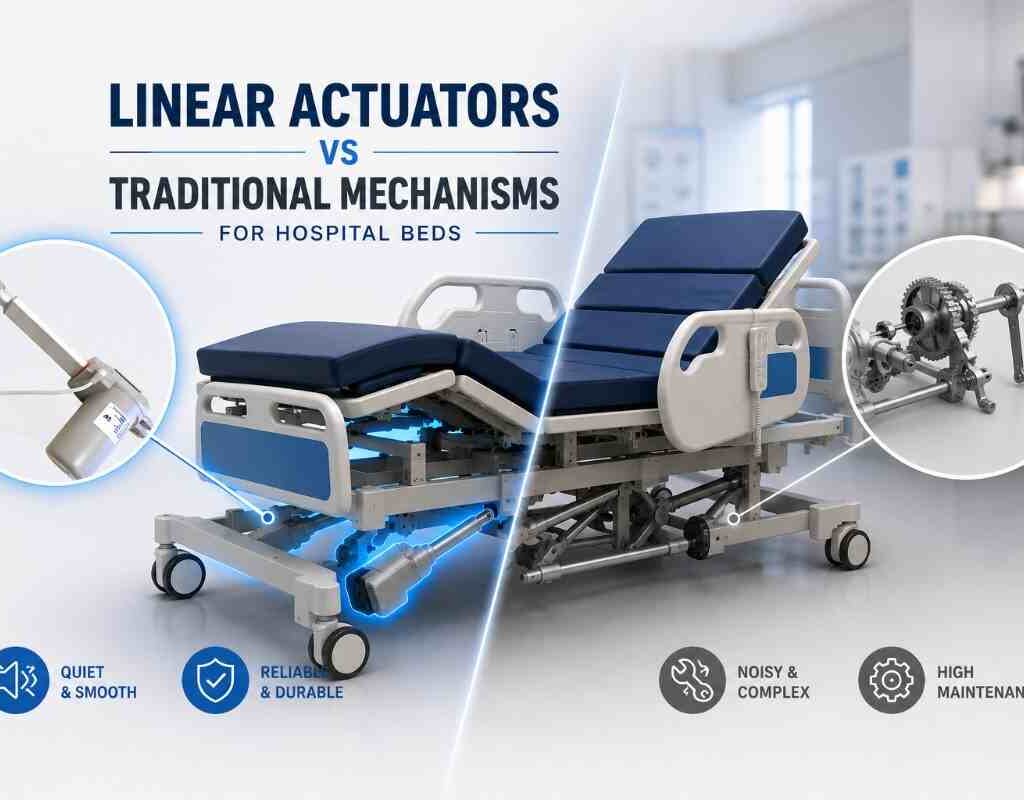
Linear Actuators vs Traditional Mechanisms for Hospital Beds

linear actuator


Modern hospital beds need Linear Actuators to do much more than support a patient. They must provide smooth positioning, reliable movement, easy operation, and dependable performance. As a result, hospital bed manufacturers are moving toward electrically adjustable designs that can support multiple bed functions.

One of the key technologies behind this movement is Linear Actuators. These systems convert electrical energy into controlled linear motion. They can adjust the backrest, leg section, bed height, tilt, and other positions with accuracy.

However, traditional mechanical mechanisms still have a place in some bed designs. So, which approach is better for modern hospital beds?

The answer depends on the bed design, required functions, operating environment, and user expectations. Still, for many modern electric hospital beds, linear actuator-based systems offer clear advantages.

What Are Linear Actuators?


A linear actuator is a device that creates controlled movement along a straight line. In an electric hospital bed, the actuator can move a specific section of the bed when the user presses a button or activates a control.

For example, one actuator can raise or lower the backrest. Another can adjust the leg section. Additional actuators can control bed height, tilt, or other movements.

The actuator works as part of a larger system. A typical setup can include the actuator, control box, hand controller, and safety functions. Together, these components allow the bed to deliver controlled and repeatable movement.

Because of this, linear actuators have become an important part of modern adjustable hospital beds.

What Are Traditional Hospital Bed Mechanisms?


Traditional mechanisms use mechanical components such as levers, linkages, gears, springs, shafts, or manually operated adjustment systems.

These mechanisms can provide basic bed positioning without relying on an electric motor. In some applications, that simplicity can be useful.

For example, a manually adjustable bed may work well where only a few basic positions are required. It can also reduce dependence on electrical components.

However, as hospital beds become more advanced, mechanical systems can become more complicated. Multiple functions may require additional linkages and components. Consequently, achieving smooth and independent movement can become more challenging.

Linear Actuators vs. Traditional Mechanisms: Key Differences


The biggest difference comes down to how the bed creates and controls movement.

Traditional mechanisms rely mainly on mechanical force and manual operation. In contrast, linear actuators use an electric motor and mechanical drive system to produce controlled movement.

This difference affects several important areas.

1. Movement and Position Control

Modern hospital beds often require precise positioning. Healthcare professionals may need to adjust the backrest or leg section to a specific position. Patients may also need frequent position changes for comfort and care.

With linear actuators, each movement can be controlled through a suitable control system. The actuator moves according to the input from the hand controller or bed control interface.

Traditional mechanisms, on the other hand, depend more heavily on manual adjustment. Therefore, achieving consistent positioning can be less convenient.

For beds with multiple adjustable functions, electric actuation offers a more practical approach.

2. Patient and Caregiver Convenience

Ease of operation matters in a hospital environment.

With an electric system, a caregiver can adjust the bed using a hand controller or integrated control panel. The patient may also operate certain functions without requiring manual assistance.

By comparison, traditional mechanisms may require physical effort. The user might need to operate a lever, rotate a handle, or manually adjust a section of the bed.

Therefore, linear actuator-based systems can improve convenience for both patients and caregivers.

3. Multiple Bed Functions

A modern hospital bed may support several functions, including:

  • Backrest adjustment

  • Leg section adjustment

  • Height adjustment

  • Trendelenburg positioning

  • Reverse Trendelenburg positioning

  • Bed tilt

Managing several functions with traditional mechanical mechanisms can require a complex arrangement of components.

Linear actuators provide a more flexible way to control individual movements. For instance, a multi-function control system can coordinate several actuators and provide dedicated control for different bed positions.

As a result, actuator-based designs are well suited to advanced electric hospital beds.

4. Smooth and Controlled Movement

Hospital bed movement should be stable and controlled. Sudden or inconsistent movement can affect patient comfort and overall usability.

A properly selected actuator can provide controlled movement at a suitable speed. The control system can also coordinate actuator operation according to the bed’s design requirements.

Traditional mechanical systems can provide reliable movement as well. However, their performance depends heavily on mechanical design, adjustment, and the condition of individual components.

Over time, wear in mechanical parts may also affect movement quality.

5. Safety and Control

Safety is another important consideration for hospital bed manufacturers.

Electric hospital beds can integrate actuator movement with control logic and safety functions. For example, a control system can manage multiple actuators and respond to specific operating conditions.

Emergency functions can also be incorporated into suitable actuator control systems. In critical situations, the bed can support predefined movements such as an emergency flat or CPR position, depending on the system design.

Traditional mechanisms can also be designed with safety in mind. However, adding advanced electronic control and coordinated movement is naturally more difficult when the system depends primarily on manual mechanical operation.

6. Design Flexibility for OEMs

Hospital bed manufacturers need flexibility when developing different models.

An OEM may want to create a basic adjustable bed for one market and a more advanced multi-function model for another. The actuator and control system can be selected according to the required functions, load conditions, stroke length, speed, and installation space.

This flexibility makes electric actuation suitable for different hospital bed configurations.

Moreover, integrated control systems can help reduce unnecessary wiring and simplify system integration when designed specifically for the application.

Are Traditional Mechanisms Still Useful?


Yes. Traditional mechanisms are not automatically outdated.

They can still make sense for basic beds where electrical adjustment is not required. They may also suit applications where simplicity, manual operation, or lower system complexity is the priority.

However, the requirements change when the bed needs several adjustable functions.

For modern hospital beds, users increasingly expect easy operation and smooth positioning. At the same time, OEMs need reliable systems that can integrate with the overall bed design. Therefore, electric actuation often becomes the more practical solution.

Why Linear Actuators Suit Modern Hospital Beds


The main advantage is not simply that an actuator moves the bed. The real benefit comes from controlled, repeatable, and electrically managed movement.

A well-designed actuator system can help manufacturers create beds that are easier to operate and more adaptable to different care requirements.

Furthermore, actuators can work together with dedicated control systems to manage several bed functions. This combination creates a complete motion-control solution rather than an isolated mechanical component.

For hospital bed OEMs, that distinction is important.

The right solution should consider more than actuator specifications alone. Load capacity, stroke length, speed, duty cycle, installation space, noise, safety requirements, and control compatibility all need careful evaluation.

Linear Actuators or Traditional Mechanisms: Which Should You Choose?


There is no single solution for every hospital bed.

If the design requires basic manual adjustment, a traditional mechanism may still be suitable. However, if the bed requires multiple functions, easy operation, precise movement, and integrated control, linear actuators offer significant advantages.

In particular, electric hospital beds with three, five, or more functions can benefit from coordinated actuator control.

Therefore, the better choice depends on the intended application. For modern, multi-function hospital beds, however, linear actuator-based systems provide a strong foundation for reliable and convenient movement.

Conclusion


Hospital bed technology continues to evolve. As beds become more adjustable and user-focused, the need for reliable motion-control systems also increases.

Traditional mechanisms remain useful for simple applications. However, Linear Actuators offer greater flexibility for modern electric hospital beds that require multiple controlled movements.

They can support smoother positioning, easier operation, flexible bed configurations, and integration with dedicated control systems.

For OEMs and medical equipment manufacturers, the key is to select an actuator and control solution that matches the bed’s functional and safety requirements. When these components are designed to work together, they can create a more reliable and user-friendly hospital bed.

Ultimately, the goal is not simply to move the bed. It is to create controlled movement that supports better usability, efficient operation, and modern patient-care requirements.
Why Linear Actuators Are Essential for Hospital Beds

Introduction

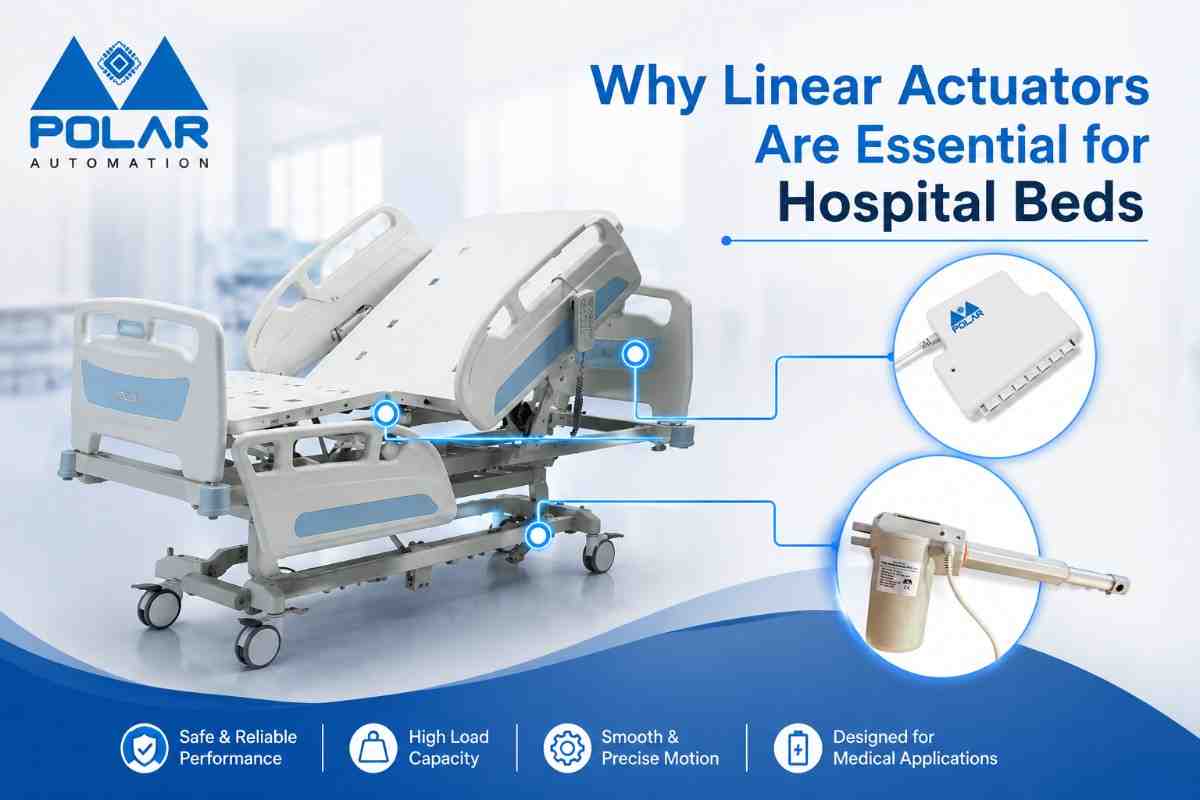
Modern hospital beds do much more than provide a place for patients to rest. Linear actuators for hospital beds play a key role in making these functions possible. They help healthcare professionals position patients safely, improve comfort, and perform routine care with less physical effort.

A linear actuator converts electrical energy into controlled linear movement. In a hospital bed, it can raise the bed, adjust the backrest, move the leg section, or tilt the complete bed platform. Multiple actuators can also work together through a hospital bed actuator control system to create several independent bed functions.

As hospitals and medical equipment manufacturers demand safer and more flexible patient-care solutions, reliable linear actuator systems have become an important part of modern electric hospital bed design.

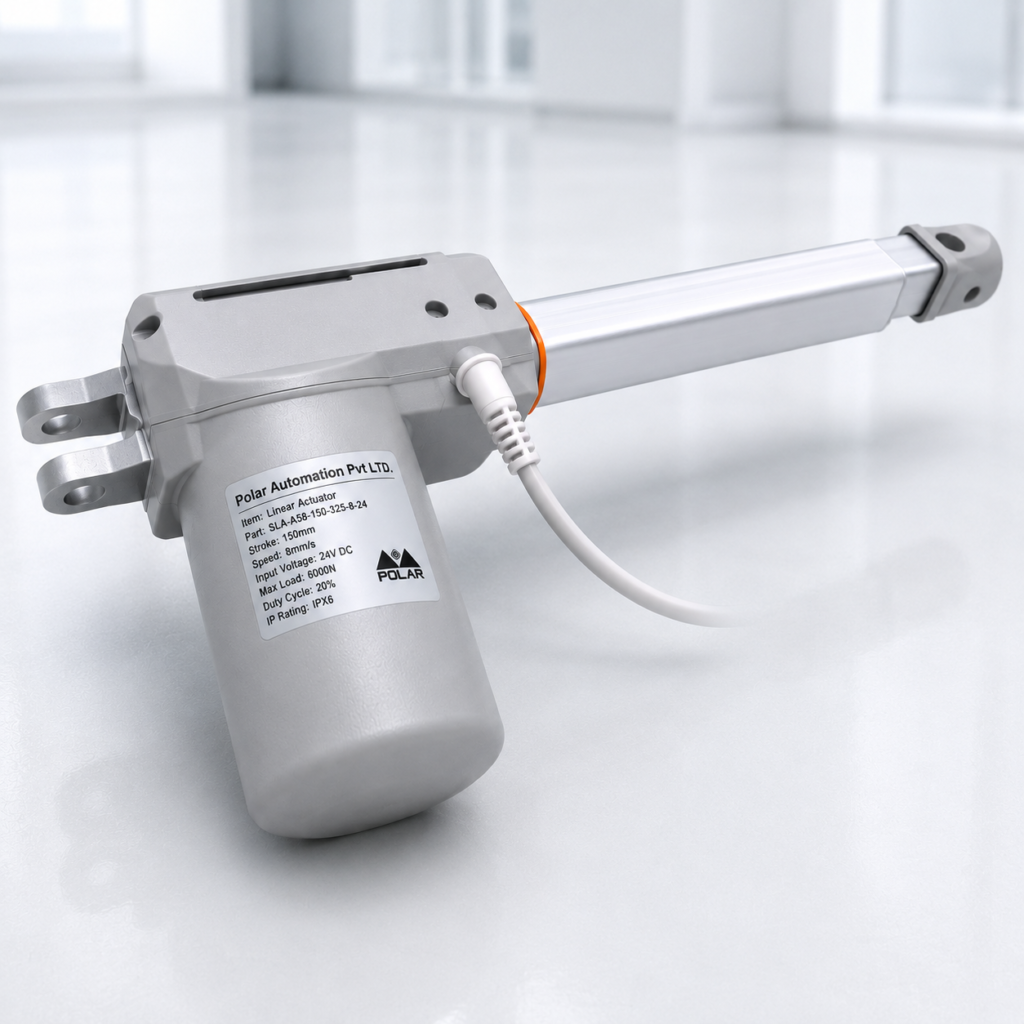
A linear actuator is an electromechanical device that creates straight-line movement. Unlike a rotary motor, which produces rotational movement, a linear actuator extends or retracts a moving shaft.

A typical electric linear actuator includes a motor, gearbox, screw mechanism, moving rod, and limit switches. When the control system sends a signal, the motor drives the screw mechanism. The rod then moves forward or backward.

In a hospital bed, this movement connects directly to a mechanical section of the bed.

For example:

Controller → Control System → Linear Actuator → Bed Movement

When the user presses a button to raise the backrest, the control system activates the relevant actuator. The actuator extends or retracts, and the backrest moves to the selected position.

This simple operating principle allows manufacturers to create precise and reliable electric hospital bed adjustment systems.

Why Are Linear Actuators Essential for Hospital Beds?

Hospital beds require controlled movement across several sections. Manual mechanisms can perform some of these adjustments, but electric actuators provide smoother operation and easier control.

A single bed may use several actuators. Each actuator can control a specific movement, while the main control unit coordinates their operation.

For example, a multi-function hospital bed may use separate actuators for:

  • Bed height adjustment

  • Backrest adjustment

  • Leg rest adjustment

  • Trendelenburg position

  • Reverse Trendelenburg position

  • Overall bed tilt

This modular approach allows OEMs to design hospital beds according to different clinical and patient-care requirements.

Key Functions of Linear Actuators in Hospital Beds


1. Bed Height Adjustment

A linear actuator can raise or lower the entire bed frame.

Height adjustment helps caregivers create a suitable working position during patient care. It also allows patients to access the bed more easily when the bed reaches a lower position.

The actuator must provide enough force and stroke length to move the bed smoothly while supporting the required load.

2. Backrest Adjustment

Backrest movement allows the upper section of the bed to move from a flat position to an inclined position.

Patients can use this function while eating, reading, communicating, or resting. Caregivers can also adjust the backrest during routine treatment and patient positioning.

A dedicated actuator provides controlled movement without requiring the caregiver to manually lift the backrest.

3. Leg Section Adjustment

A separate actuator can control the leg or knee section of the bed.

This function gives caregivers more control over patient positioning. It can also work together with the backrest actuator to create a comfortable seated or reclined position.

4. Trendelenburg and Reverse Trendelenburg

Some advanced hospital beds use actuators to tilt the complete bed platform.

Trendelenburg tilts the patient’s head lower than the feet, while reverse Trendelenburg raises the head relative to the feet.

These movements require accurate coordination between the bed’s mechanical structure and actuator control system.

5. Bed Tilt

Linear actuators can also support lateral or overall bed tilting, depending on the bed design.

This function gives healthcare professionals additional positioning options. It also demonstrates why actuator synchronization matters in multi-function hospital beds.

Linear Actuator

Benefits of Linear Actuators for Hospital Beds


Improved Patient Comfort

Electric actuator systems allow users to adjust the bed position without manually moving heavy sections. Patients can achieve more suitable positions for rest and daily activities.

Precise Positioning

Linear actuators provide controlled movement. With the right actuator specification and control system, manufacturers can achieve accurate positioning and repeatable movement.

Reduced Manual Effort

Caregivers do not need to manually lift or adjust heavy bed sections. A simple control input can activate the required actuator.

This can make routine patient care more convenient and reduce unnecessary physical effort.

Better Caregiver Ergonomics

Height-adjustable hospital beds allow caregivers to bring the bed to a suitable working level. This can support better ergonomics during bedside procedures and routine care.

Flexible Bed Design

Multiple actuators allow manufacturers to create different bed configurations. A basic bed can use fewer actuators, while an advanced ICU or critical-care bed can use several actuators for more positioning functions.

Smooth and Controlled Movement

Electric linear actuators can provide controlled extension and retraction. When manufacturers match the actuator’s speed, force, stroke, and duty cycle to the application, the bed can achieve consistent movement.

Easier Integration

Modern actuator systems can integrate with hand controllers, nurse control panels, foot switches, and central bed control units. This gives OEMs flexibility when designing the user interface.

Applications of Linear Actuators in Hospital Beds


Linear actuators support many types of medical and healthcare beds.

Hospital Patient Beds

General hospital beds use actuators for common functions such as height, backrest, and leg adjustment. These functions support everyday patient care.

ICU Beds

Intensive care beds often require more advanced positioning. Multiple actuators can work together to provide several controlled movements.

Electric Nursing Beds

Nursing and long-term care facilities can use actuator-driven beds to improve patient comfort and simplify daily care.

Home Care Beds

Electric home-care beds use compact actuator systems to provide powered positioning for patients who need extended support at home.

Rehabilitation Beds

Rehabilitation facilities can use adjustable beds to support different stages of patient recovery and mobility.

Specialty Medical Beds

Special-purpose beds may require additional movement functions. Manufacturers can select actuator configurations based on the specific application and mechanical design.

What Should Manufacturers Consider When Selecting a Hospital Bed Actuator?


Choosing an actuator requires more than checking its maximum load. The actuator must match the complete mechanical and electrical design of the bed.

Important factors include load capacity, stroke length, speed, retracted length, duty cycle, operating voltage, noise level, mounting configuration, and protection rating.

Manufacturers should also consider how the actuator will work with the control system. Multi-actuator beds need reliable synchronization and appropriate safety logic.

For example, a five-function hospital bed may coordinate several actuators through one central control system. The system should provide predictable movement and prevent conflicting commands.

Emergency functions also require careful planning. Depending on the bed design, manufacturers may include features such as emergency flat or CPR positioning, actuator overload protection, limit control, and handset lockout.

The final actuator specification should always match the bed’s mechanical requirements, intended application, and applicable medical-device requirements.

The Role of the Hospital Bed Actuator Control System

Actuators provide movement, but the hospital bed actuator control system manages how that movement happens.

The control system receives commands from the user interface and sends signals to the correct actuator. In a multi-function bed, it can coordinate several actuators and manage predefined movement sequences.

For example, pressing a single button may trigger a specific combination of actuator movements. The controller can also support functions such as emergency positioning, movement limits, and selected safety controls.

Therefore, the actuator and controller should work as one integrated system. A high-quality actuator alone cannot deliver the desired performance if the control architecture does not match the bed design.

Conclusion

Linear actuators for hospital beds are essential because they transform electrical commands into controlled mechanical movement. They allow modern hospital beds to adjust height, backrest, leg sections, tilt, and other positions with less manual effort.

Their benefits extend beyond movement. Properly selected actuators can support patient comfort, precise positioning, caregiver ergonomics, flexible bed design, and reliable operation.

For medical equipment manufacturers and hospital bed OEMs, actuator selection should consider the complete system rather than one component alone. The actuator, mechanical structure, control unit, user interface, and safety logic must work together.

As electric hospital beds continue to evolve, linear actuator technology and multi-actuator control systems will remain important for creating practical, responsive, and user-friendly patient-care solutions.