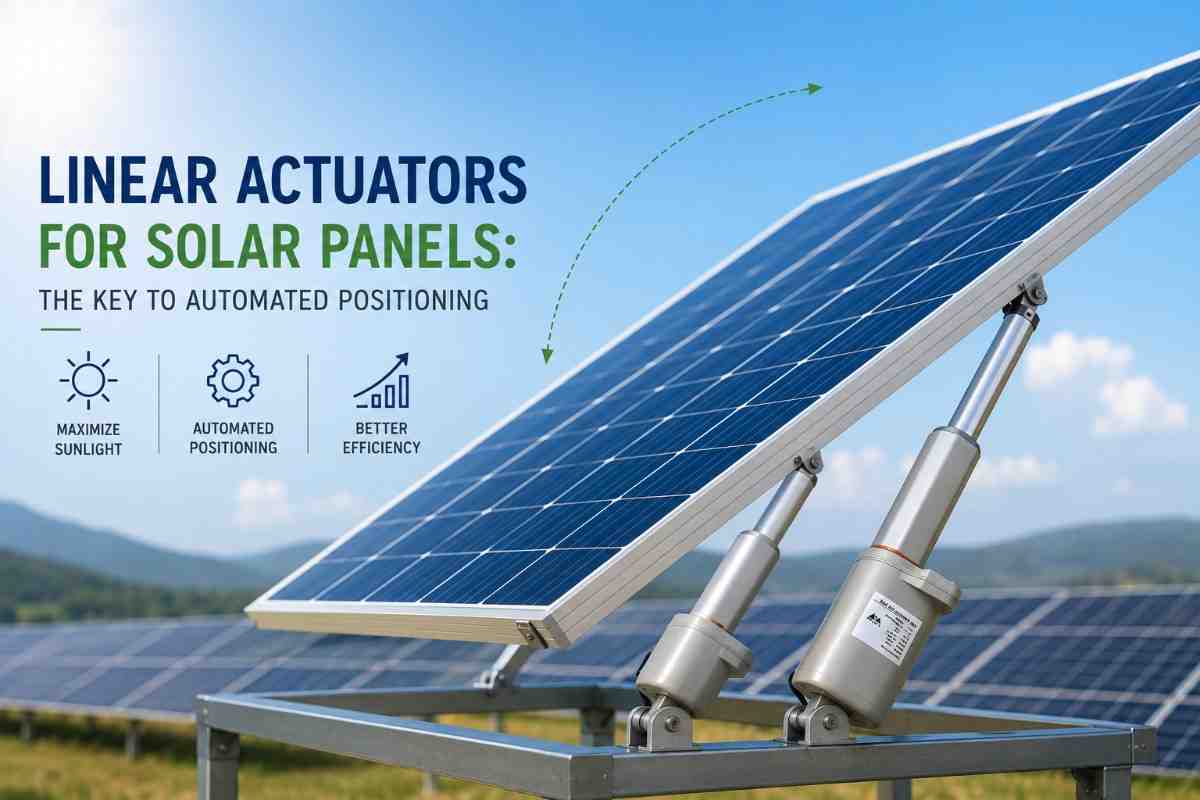
The sun does not stay in one position throughout the day. Its angle changes from morning to evening and varies across seasons. As a result, a fixed panel position may not always provide the best orientation toward the sun.
An adjustable solar panel stand can respond to these changes by moving the panel to a preferred angle. This movement can support better solar exposure and make the mounting structure more adaptable to different operating conditions.
For example, a system can adjust the panel angle at selected times during the day. A controller can also coordinate movement based on programmed positions or sensor inputs. This creates a more responsive solar mounting system without requiring manual adjustment.
The challenge is finding a compact and dependable mechanism that can deliver controlled movement. This is where linear actuators become valuable.
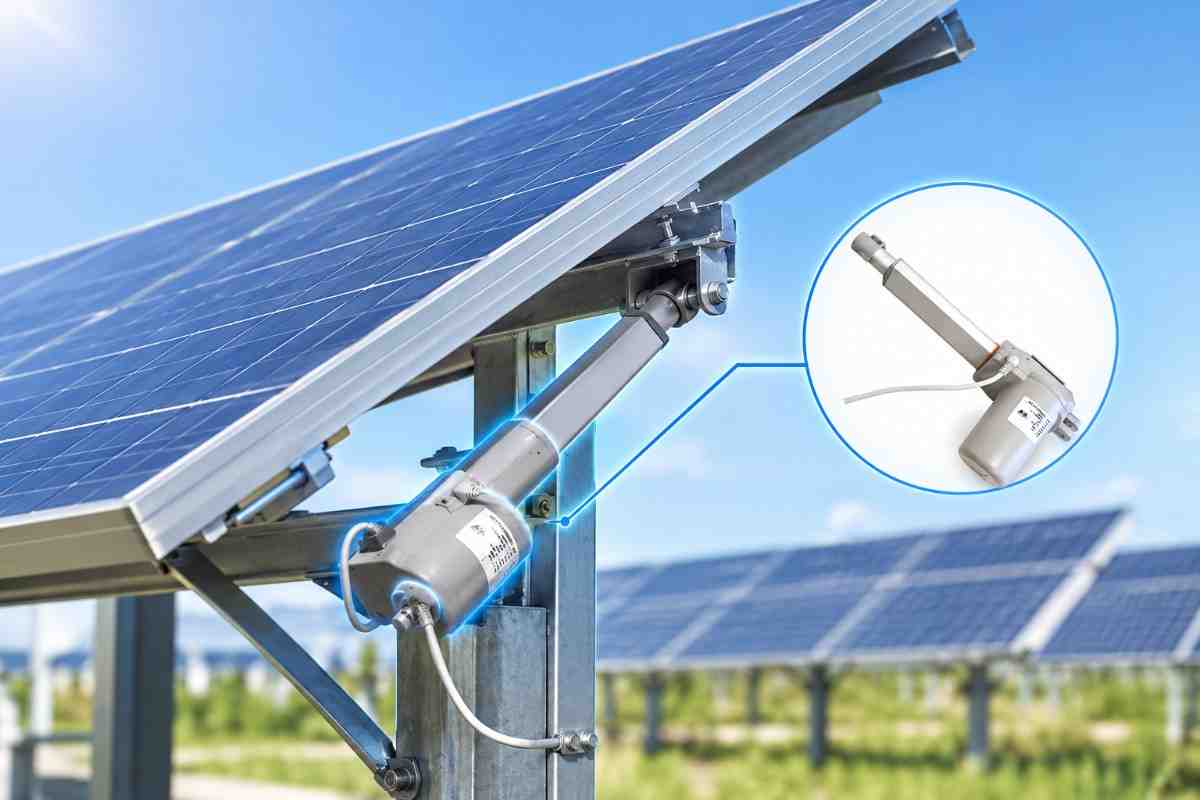
A linear actuator is a device that converts rotational motion into controlled linear movement. Depending on the design, it can extend or retract a rod to move a connected structure.
In a solar mounting application, the actuator can connect between the mounting frame and the supporting structure. When the actuator extends or retracts, it changes the angle of the solar panel.
The concept is simple, but the actuator plays an important role in controlling the physical movement of the system.
An electric linear actuator can also work with switches, timers, sensors, PLCs, or other control electronics. This flexibility makes it suitable for automated solar positioning applications where controlled and repeatable movement matters.
A typical adjustable solar panel system combines several components. These may include the solar panel frame, mounting structure, actuator, controller, power supply, and positioning or control mechanism.
The controller determines when the panel needs to move. It then sends a signal to the actuator. The actuator extends or retracts according to the required movement, which changes the panel’s angle.
Once the desired position is reached, the actuator can stop. The controller can repeat this process at different intervals or respond to changing input conditions.
For example, a solar system may use programmed movement throughout the day:
Morning → Midday Position → Afternoon Position → Evening Position
This approach allows the mounting system to make controlled adjustments rather than relying on manual positioning.
1. Precise Movement
Solar panel positioning often requires controlled movement rather than sudden or uncontrolled changes. Linear actuators can provide consistent extension and retraction, allowing the system designer to control the movement of the panel.
This makes them useful for applications where accurate positioning is important.
2. Easy System Integration
Linear actuators can integrate with different control systems. Depending on the application, the actuator can work with switches, timers, sensors, PLCs, or dedicated electronic controllers.
This allows manufacturers to develop solutions ranging from simple adjustable stands to fully automated solar positioning systems.
3. Compact and Practical Design
Space can be an important consideration in solar mounting systems. A compact actuator can provide the required linear movement without adding a complex mechanical arrangement.
Its straightforward installation can also simplify the overall mechanical design.
4. Controlled and Repeatable Operation
An automated solar mounting system may need to perform the same movement repeatedly. A suitable linear actuator can support consistent operation over multiple adjustment cycles.
This repeatability helps create a predictable positioning system and reduces the need for manual intervention.
5. Reduced Manual Adjustment
Manual adjustment can become inconvenient, especially when solar panels are installed at height or across a large area. Automation allows the system to make scheduled or controlled adjustments without requiring an operator to physically reposition the panel.
Not every actuator will suit every solar mounting system. The actuator should match the mechanical and environmental requirements of the application.
Load capacity is one of the first factors to consider. The actuator must handle the force required to move the panel and mounting structure safely.
Stroke length also matters. It determines how far the actuator can extend or retract and therefore affects the available adjustment range.
Speed is another consideration. The required movement speed depends on the panel size, mounting design, and control strategy. Solar positioning usually focuses on controlled movement rather than very high speed.
The operating environment also deserves attention. Outdoor solar installations can expose equipment to dust, moisture, temperature changes, and other environmental conditions. Therefore, the actuator’s construction and protection level should match the installation environment.
Finally, consider duty cycle, mounting arrangement, power requirements, and control compatibility before selecting an actuator.
Adjustable solar panel systems can support a wide range of applications. They can be considered for residential solar installations, commercial rooftops, solar farms, agricultural systems, remote power installations, and specialized solar equipment.
They can also benefit applications where the available installation space requires flexible panel positioning.
For OEMs and system integrators, actuator-based designs provide an opportunity to develop customized solar mounting solutions around specific panel dimensions, movement requirements, and control systems.
The actuator may look like a small part of a solar mounting system, but its performance can influence the reliability of the complete mechanism.
An actuator with unsuitable force, stroke, speed, or environmental protection can affect system performance. On the other hand, the right actuator can provide smooth and dependable movement while simplifying mechanical integration.
For this reason, actuator selection should begin with the complete application. Panel weight, mounting geometry, required movement, installation conditions, power supply, and control method should all be considered together.
Solar technology continues to move toward smarter and more automated systems. As automation becomes more accessible, adjustable mounting solutions can offer manufacturers new ways to improve flexibility and control.
Linear actuators provide a practical connection between electronic control and mechanical movement. A controller can make a decision, while the actuator performs the physical adjustment.
This combination makes linear actuator technology useful for developing modern solar positioning systems that require reliable, controlled movement.
An adjustable solar panel stand can provide greater flexibility than a fixed mounting structure, especially when the application requires controlled changes in panel angle. Linear actuators for solar panels offer a practical way to create this movement.
From precise positioning and easy control integration to reduced manual adjustment, linear actuators can support the development of smarter solar mounting systems. However, choosing the right actuator requires careful consideration of load, stroke, speed, duty cycle, environmental conditions, and installation requirements.
For OEMs, solar equipment manufacturers, and system integrators, the right linear actuator can turn a basic adjustable structure into a reliable automated positioning solution. As solar systems continue to evolve, controlled linear motion will remain an important part of building smarter and more adaptable solar technologies.
Polar Automation develops linear actuator solutions designed for applications that require reliable and controlled motion. With the right actuator and control approach, solar manufacturers can create adjustable panel systems that are practical, efficient, and ready for automation.